Feeds:
Posts
Comments

In my last post I introduced some of the controversies surrounding breast (and prostate) cancer screening methods.  I’ve been digging into the research on screening mammography for an assignment for the radiology elective I just finished, and realized there is definitely more on this subject that I want to write about.


I’ve been focusing my reading on the perceptions (and misconceptions) about mammography, both on the side of physicians and patients (though breast cancer awareness has become such a public issue, I wish there was research looking at general awareness about cancer, not just awareness in women of screening age- but I digress…).


So how effective is mammography?


Over the years, quite a lot of data has been generated looking at the ability of screening mammography to prevent death from breast cancer.  I’m not going to dig into all the data now, but I want to mention the most recent Cochrane Review (the “Holy Grail” of Evidence Based Medicine (EBM)) and the 2012 New England Journal of Medicine (NEJM) article that I mentioned in my last post.


Here is an excerpt from the 2011 Cochrane Review (emphasis mine):


…for every 2000 women invited for screening throughout 10 years, one will have her life prolonged and 10 healthy women, who would not have been diagnosed if there had not been screening, will be treated unnecessarily. Furthermore, more than 200 women will experience important psychological distress for many months because of false positive findings. It is thus not clear whether screening does more good than harm.  [1]


And from the NEJM (emphasis mine):


Despite substantial increases in the number of cases of early-stage breast cancer detected, screening mammography has only marginally reduced the rate at which women present with advanced cancer. Although it is not certain which women have been affected, the imbalance suggests that there is substantial overdiagnosis, accounting for nearly a third of all newly diagnosed breast cancers, and that screening is having, at best, only a small effect on the rate of death from breast cancer. [2]


So the eminent minds in evidence based medicine think that it’s unclear if mammograms do more harm than good?  That certainly isn’t the public message that most of us have heard…


Liars, damn liars, and statisticians


Part of the difficulty of understanding the benefits (and the risks) of mammography is understanding the statistics.  Unfortunately, despite being taught some basics in medical school, I fear that many med students and physicians aren’t good at interpreting data.  Indeed, a 2009 paper found that the vast majority of ob/gyns couldn’t accurately calculate the positive predictive value of a positive mammogram [3].


Even if a physician is statistically literate, data can appear much more or less convincing depending on how it’s presented.  A 2011 article entitled “There is nothing to worry about”: Gynecologists’ counseling on mammography” gives some excellent examples [4]. Working with data published in 1996 from a randomized study conducted in Sweden, they emphasize the difference in absolute risk reduction and relative risk reductions.  In the 1996 study, for every 1000 women that were screened there was a decrease in breast cancer deaths from four to three women in favor of the screened group.  An absolute reduction in breast cancer deaths of 1 woman for 1000 screened does not sound particularly impressive, but the relative statistic of “a 25% decrease in mortality” sounds worthwhile [5]. [It is also worth noting that according to the Cochrane review above, the reduction in breast cancer mortality with screening mammography is actually 1 in 2000, or a 15% decrease in relative mortality or a 0.05% decrease in absolute mortality.]


When the data is presented as relative risk reduction and not absolute risk reduction, screening mammography looks a lot more beneficial.  Interestingly, the risks of mammography (those of overdiagnosis and over treatment) are often presented as absolute rather than relative risks, seemingly downplaying the adverse consequences while exaggerating the benefits.


It’s not just relative…


Other mammography statistics can also be used to skew the perception of benefits.  One statistic that has largely fallen out of favor, because of loud protestation from those calling for a realistic analysis of the benefits of mammography, is “survival statistics”.


To understand survival statistics we much first understand “lead time” and “lead time bias”.  Wikipedia does a good job explaining this phenomenon, but for those that don’t want to take the time to click over- I will briefly expand.


Imagine a disease that kills a person at 65.  Imagine that the person becomes symptomatic for that disease at 63, but with the use of a screening tool we can detect (but not cure) that disease at 55.  The “diagnosis” is given when the disease is first detected, so the person diagnosed at 63 dies 2 years after diagnosis.  The person whose disease was identified at 55 “survives” for 10 years, which sounds great- except really there is no difference in total life expectancy.  Similarly, if you detect a “disease” that would never kill in the first place you can have stunning survival data…


Side note: The cancer that isn’t


No one questions that breast cancer kills.  The problem is that “breast cancer” is not a single entity, and some of the things that are classified as breast cancer aren’t even in the same ballpark as the diseases that kill.  Case in point is Ductal Carcinoma in situ (DCIS).  Despite having the word “carcinoma” in its name, calling DCIS “cancer” isn’t really fair, though it can progress to cancer.  Sadly we don’t know when, why, or in whom it will progress to invasive cancer.  However, in the majority of women it just sits there, in situ, and is something the woman dies (or would die, if it were left alone,) with, not from [6].  Including the diagnosis of DCIS in survival statistics further skews an already questionable statistic.


Back to stats…
 

Promoting mammography by saying that it increases 5-year survival from 23% to 98% sounds impressive, while the actual reduction in the chance of a woman in her fifties dying from breast cancer over the next ten years only drops from 0.53% to 0.46% with mammography [7].


Perception


If you’ve made it this far, you (like me) may be becoming underwhelmed with the evidence supporting the regular use of screening mammography (and that’s without starting to consider the financial incentives that might encourage the promotion of early and often mammography…).


Unfortunately, if I poll most of my fellow classmates, they will emphatically reply that screening mammography is a good thing. It catches cancers (yes). It saves lives (marginally). It’s highly beneficial (that’s debatable).


This sentiment is not unique amongst my classmates.  A recent survey shows that over 80% of responding primary care physicians believe screening mammography to be “very effective” in reducing breast cancer mortality in women aged 50-69 [8]. Another study reported that 54% of responding physicians believe that screening mammography is “very effective” at reducing cancer mortality in women aged 40-49 [9], a population where screening mammography decreases the 10 year risk of dying from breast cancer from 0.35% to 0.3% [7]. In yet another study, none of the 20 gynecologists queried mentioned risks of mammography such as over-diagnosis and over-treatment [4].


Sentiments amongst patients are similar. A 2001 study found that only 19% of women surveyed accurately assessed screening efficacy realistically, selecting that screening reduced mortality by about 25% in women over 50 (and again, this number is probably closer to 15% according to the most recent Cochrane report, and is equivalent to 1 less death per 2000 women over ten years).  50% of the women who responded estimate that screening mammography reduced breast cancer mortality by 50-75%.  Not surprisingly, women who believed that screening was effective were more likely to plan to have a mammogram [10].


Women’s sentiments towards mammography are shaped by many factors.  Patients, like physicians, are largely influenced by personal experiences.  “Knowing someone who survived” can largely influence personal beliefs, as can the media and statements from celebrities and politicians.  The type of media a woman gets her information from can also largely influence her perspective.  A 2001 paper found that publications aimed towards women with lower education levels published articles that were clearly persuasive or prescriptive for screening mammography, while publications aimed towards more educated women included more balanced and informative messages [11].  Therefore, perhaps it is not surprising that higher levels of education are associated with more realistic expectations of mammography [12].


So what’s the Cliff-Notes version


Despite what many of us have come to believe, screening mammography is not womankind’s salvation in pink.  Alas, it appears that survival (as in real survival, not a 5 year statistic) is basically unchanged whether women participate in screening mammography or not.  Women that do participate also face the sizable risk of experiencing negative repercussions from mammography: false positives (being told there’s something there when there’s not- this is particularly prevalent in younger populations), over diagnosis, and over treatment.


I don’t want to downplay breast cancer.  Breast cancer is real.  Breast cancer is terrible.  Breast cancer kills. But the statistics show that whether women are screened or whether a cancer is caught with diagnostics after a lump is appreciated, population survival is largely unchanged.  Furthermore, women suffer ill consequences from over diagnosis and over treatment from screening mammography.


So what should we do?


Some of the screening recommendations are heading in the right direction.  While the American College of Gynecologists (ACOG) and the American Cancer Society (ACS) recommend that women initiate annual screenings at the age of 40, the most recent US Preventative Task Force (USPTF) recommendations recommend starting biennial mammograms at 50.


Personally, I think the USPTF is heading in the right direction, but I, for one, would like to see a mammography recommendation similar to the recommendations for PSA testing for men given by the American Urology Association as I wrote about in my last post.  We shouldn’t do it in the young (read 40-50), we shouldn’t do it in the old (and instead of “old” we really need to talk about life expectancy), and those patients in the middle need to have a serious talk with their doctor about the risks, benefits, and their personal values.


We need personalized medicine.  Instead of a carte blanche recommendation about when to start mammography, we need real discussions about an individual’s risks, their values, and the potential benefits and risks of screening.  Of course- that’s a lot more difficult than handing a prescription for a mammogram to every 40 year old woman who walks through the door, but I think that as doctors, we are up to the challenge. 


Of course, doctors aren’t up for the challenge if they’re only given 5 minutes to talk to a patient.  We need to value primary care doctors, and the doctor patient relationship, if we’re going to make strides towards personalized medicine- the question is whether the system is up to that challenge, but that’s a question for another day. 


1.            Gotzsche, P.C. and M. Nielsen, Screening for breast cancer with mammography. Cochrane Database Syst Rev, 2011(1).

2.            Bleyer, A. and H.G. Welch, Effect of three decades of screening mammography on breast-cancer incidence. N Engl J Med, 2012. 367(21): p. 1998-2005.

3.            Gigerenzer, G., Making sense of health statistics. Bull World Health Organ, 2009. 87(8): p. 567.

4.            Wegwarth, O. and G. Gigerenzer, “There is nothing to worry about”: gynecologists’ counseling on mammography. Patient Educ Couns, 2011. 84(2): p. 251-6.

5.            Nystrom, L., L.G. Larsson, S. Wall, L.E. Rutqvist, I. Andersson, N. Bjurstam, G. Fagerberg, J. Frisell, and L. Tabar, An overview of the Swedish randomised mammography trials: total mortality pattern and the representivity of the study cohorts. J Med Screen, 1996. 3(2): p. 85-7.

6.            Welch, H.G., S. Woloshin, and L.M. Schwartz, The sea of uncertainty surrounding ductal carcinoma in situ–the price of screening mammography. J Natl Cancer Inst, 2008. 100(4): p. 228-9.

7.            Woloshin, S. and L.M. Schwartz, How a charity oversells mammography. BMJ, 2012. 345: p. e5132.

8.            Yasmeen, S., P.S. Romano, D.J. Tancredi, N.H. Saito, J. Rainwater, and R.L. Kravitz, Screening mammography beliefs and recommendations: a web-based survey of primary care physicians. BMC Health Serv Res, 2012. 12: p. 32.

9.            Meissner, H.I., C.N. Klabunde, P.K. Han, V.B. Benard, and N. Breen, Breast cancer screening beliefs, recommendations and practices: primary care physicians in the United States. Cancer, 2011. 117(14): p. 3101-11.

10.            Chamot, E. and T.V. Perneger, Misconceptions about efficacy of mammography screening: a public health dilemma. J Epidemiol Community Health, 2001. 55(11): p. 799-803.

11.            Dobias, K.S., C.A. Moyer, S.E. McAchran, S.J. Katz, and S.S. Sonnad, Mammography messages in popular media: implications for patient expectations and shared clinical decision-making. Health Expect, 2001. 4(2): p. 127-35.

12.            Domenighetti, G., B. D’Avanzo, M. Egger, F. Berrino, T. Perneger, P. Mosconi, and M. Zwahlen, Women’s perception of the benefits of mammography screening: population-based survey in four countries. Int J Epidemiol, 2003. 32(5): p. 816-21.

I abhor the pinkification of our culture.


I have nothing against the color pink (for a brief time in my childhood, after wearing a princess-like peach bridesmaid dress at my aunt’s wedding, peach was actually my favorite color), but I do have a deep dislike of the culture of cancer that has grabbed pink ribbons (or pink cookware, clothes, and even garbage barrels) to raise awareness *cough* money *cough* for foundations that make a big deal out of breast cancer.


I don’t want to downplay breast cancer.  According to The American Cancer Society, breast cancer is the most common cancer among American Women after skin cancer.  It is estimated that around 40,000 women will die from breast cancer this year.  But breast cancer awareness is also a BIG money maker- turning over many million dollars per year.


I’ve yet to see this movie, but the trailer raises some interesting points.


http://www.youtube.com/watch?v=3QPZfcYTUaA


All the pinkification and fanfare would be tolerable if the breast cancer awareness campaigning, and most importantly the mammography that it promotes, reduced the toll of breast cancer, but the reality, according to a November 2012 New England Journal of Medicine article [1], is not such a pretty picture.


Let’s cover some of the basics…


To be an effective screening tool, a modality must detect life-threatening disease at an early treatable stage.  It follows that an effective screening tool then decreases the prevalence of late stage disease.


While screening mammograms have certainly led to an increased detection of breast lesions (it has effectively doubled the rate of diagnosis), the reality is that this increase in detection has not led to a significant decrease in advanced disease.  [The NEJM abstract is here, and certainly worth a read]. Furthermore, it appears that increased detection has had, at best, only a small effect on the rate of death from breast cancer.


What the NEJM of article doesn’t cover is the psychological toll that the pinkification of our culture has had.  Women feel like they are failing themselves if they don’t start getting annual mammograms at the age of 40.  Teenage girls are being brought up to believe that their breasts are two pre-cancerous lesions… ticking time bombs.


Yes- breast cancer kills, but there are also plenty of breast lesions that women have that they would live and die with, not from, if it weren’t for aggressive screening recommendations.  I’m not a psychiatrist (and I’m not going to be), but I do wonder what the increased diagnosis (and then “survival”) of otherwise slow-growing and relatively benign cancers does to the psyche – the survivor effect.  These factors raise a number of concerns, without even bringing up any monetary issues…


Apparently the prostate cancer ribbon is blue, but men (and our culture) seem to have avoided a tidal wave of “bluification”.  Perhaps, as the gender that tends to utilize the healthcare system less, [2], men have been seen as a less lucrative target. Nonetheless, prostate cancer has fallen victim to some of the same pitfalls (abuses?) as breast cancer.


Prostate cancer is the most common non-skin malignancy and the second leading cause of cancer death in men. Prostate specific antigen [PSA] is a protein that can be detected in the blood, and until fairly recently it had been recommended that men undergo regular PSA testing as a screening for prostate malignancy.


The problem with PSA testing however, much like mammography, is that it catches many lesions that a man would die with, not from.  As with mammography, increased detection leads to increased treatment, increased surgery, increased patient stress, and increased financial burden for the patient and the system. And for what?


Many of the lesions that PSA screening catches do not negatively impact the life expectancy of the patient.  In fact, a paper published yesterday in the Annals of Internal Medicine [3] shows the opposite- that treating these lesions (instead of observing them), actually leads to a decrease in quality-adjusted life expectancy (and increased medical costs).


What does this all mean?  Should we give up on screening tests for the two big sex-specific cancers?


No- I’m not a nihilist when it comes to screening, but I do think that screening should be done with full patient awareness of the risks, benefits, and consequences.


I think the American Urological Association (AUA) is on the right track, with their 2013 guidelines that greatly limit the recommendations for PSA testing (these came after the 2012 US Preventative Taskforce recommendations, which advised against the use of all PSA screening). While the AUA made general recommendations for some populations that PSA screening is unnecessary (those with a low-risk who are young, those who are old, and those with less than a 10-15 year life expectancy), for a large group the recommendation is that men should talk to their doctors about the relative risks and benefits, and from that discussion make a decision based on their personal values and preferences.


Having a patient weigh in with his personal values doesn’t seem like a particularly groundbreaking recommendation, but in many ways it is.  A patient’s medical care should be in his hands as much as possible, and when the risks and benefits of a screening tool are unclear it is appropriate that the patient and doctor discuss the risks and benefits.  Looking back at the data on mammography over the last few years, I think it is only right that doctors start to have similar discussions with women about their personal values and preferences when it comes to mammography. [The elephant in the room, however, is that if screening tests are deemed “optional”, will insurance companies cover them?]


So where does that leave us.   


Screening MAY catch an early cancer, but it may also catch a lesion that you would die with not from.  It can lead to extensive testing, stress, expenses, and surgery.  I’m not saying we shouldn’t screen, but I’m saying that the medical community (and the organizations that profit from cancer-awareness) need to be honest about the reality of our testing modalities.


I also think this is a call to arms for scientists.  The screening tests we have are not meeting our needs.  While the tests above can tell us about potential lesions, they tell us little about the malignancy of the lesions.  We need tests that can more accurately tell us what is going on in our bodies.  Those tests are coming- in the forms of mRNA and protein assays, but until they get here I think we ought to have more informed discussions about what screening tests are really doing today.


1.            Bleyer, A. and H.G. Welch, Effect of three decades of screening mammography on breast-cancer incidence. N Engl J Med, 2012. 367(21): p. 1998-2005.
2.            Bertakis, K.D., R. Azari, L.J. Helms, E.J. Callahan, and J.A. Robbins, Gender differences in the utilization of health care services. J Fam Pract, 2000. 49(2): p. 147-52.

3.            Hayes, J.A., D.A. Ollendorf, S.D. Pearson, M.J. Barry, P.W. Kantoff, P.A. Lee, and P.M. McMahon, Observation Versus Initial Tretment for Men with Localized, Low-Risk Prostate Cancer: A Cost-effectiveness analysis. Annals of Internal Medicine, 2013. 158(12): p. 853-860.

OK- enough (for now) of the photo documentation of my past month of explorations!  While I am keen to write more about the environment, wildlife, and general experience of my last month in Utah, it’s time for me to get back to the reality of a med student and think (and write) about medicine.


A number of schools (and programs) offer Wilderness Medicine electives for medical students, but I chose (and was fortunate to get a spot in) the elective offered by UMass Medical School.  A few things drew me to this program.  First- it has been running for 20 years, so I initially suspected they were doing something right.  Second- many Wilderness Medicine courses are taught in classrooms with field trips and forays “into the wild” for practical experiences.  The UMass course is taught in the wild. With the exception of our first day of lecture, conducted in a hotel meeting room, all our lectures were done outside on snow, in boats, on beaches, or sitting in the desert.  Thirdly- we got to experience three different environments in the course of three weeks.  A few other courses are taught in the wild, but they are taught in a single environment.  Utah gave us access to three, very different, environments (as shown in my previous posts: alpine, river, and desert).


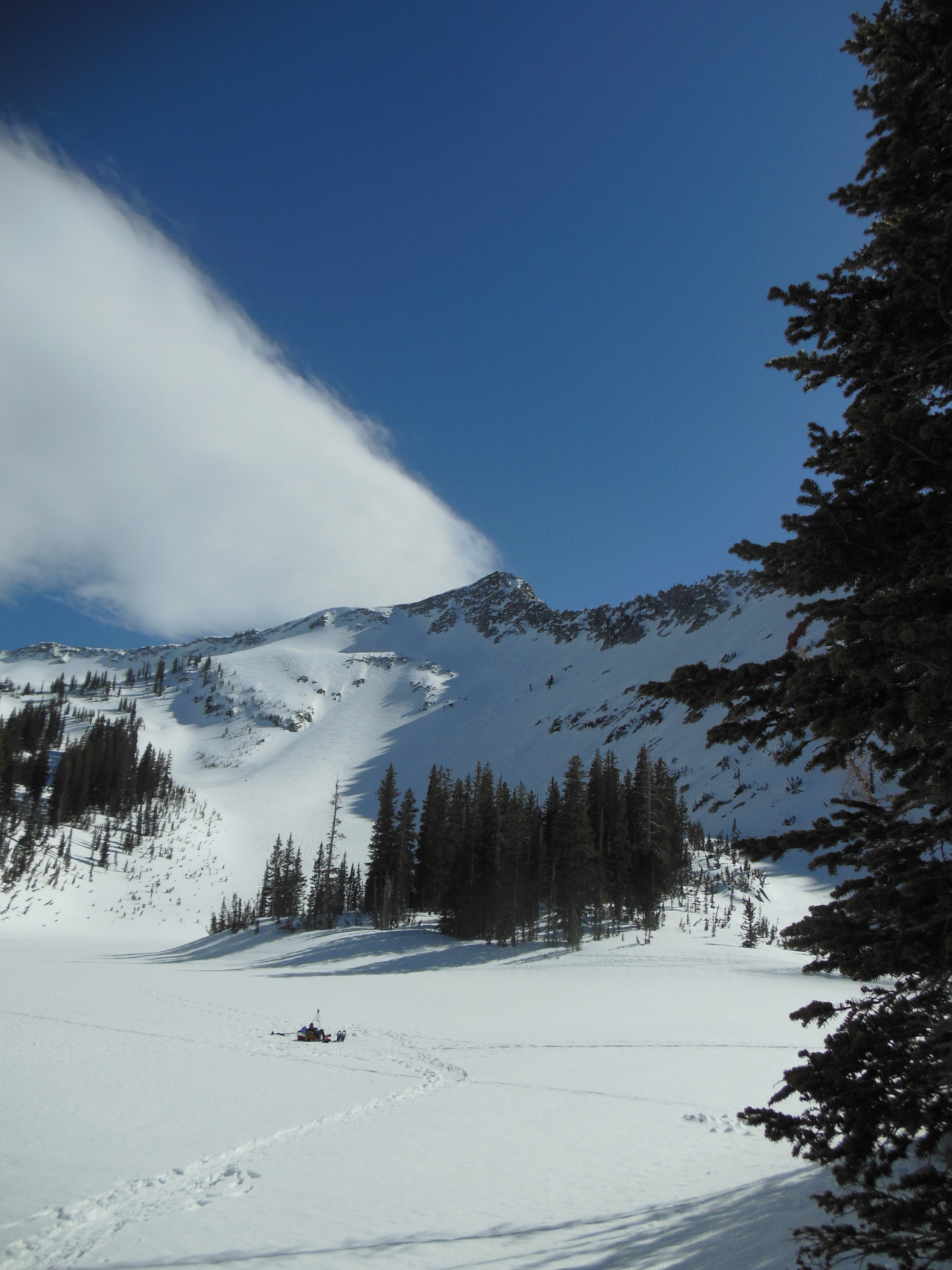
This was our main classroom in the alpine section.  We'd just arrived and are taking a quick break before setting camp, but this area was left open and we would congregate here for lectures.

This was our main classroom in the alpine section. A classmate snapped this shortly after we arrived when we were taking a quick break before setting camp, but this area was left open and we would congregate here for lectures. 


When I initially described this course to friends and acquaintances, many suggested that this course was basically Outward Bound for doctors.  The answer, I suppose, is yes and no.  There was certainly a lot of medical learning done in this class, but we also gained life skills that will not only help us in future endeavors in the wild but will also give us confidence as we go forward in our medical careers.  Broadly, it taught us to have confidence in our decisions and to use what we have available to do the best that we can.  I’m unlikely to ever have to improvise a splint in the Emergency Room, but knowing that I can, and having that confidence, will carry me and my classmates a long way as we progress to interns, residents, and one day attending physicians.


As you might expect, the medical topics that we covered were married to the environments and activities we were doing.  Before heading out on our first big trek we had a thorough lecture on blister pathophysiology, prevention, and treatment. Once in the alpine, we promptly learned about hypothermia, and how to create a hypowrap to help someone with hypothermia.  We learned about frostbite and non-freezing cold injury, as well as thermal burns, sunburns, and sun blindness.  While in the mountains, we also discussed various problems that occur at high altitude.


A lot of injuries in the wild are orthopedic, so we had multiple sessions on splinting, immobilizing, and caring for these injuries.  We also learned various lifts, rolls, and carries, utilizing minimal equipment- since you don’t always have a backboard and a team of people to help you.  Along those lines, we learned just how difficult it is to litter carry someone out of a bad situation (you need about 18 people to go 1 mile, and it will take you a LONG time).


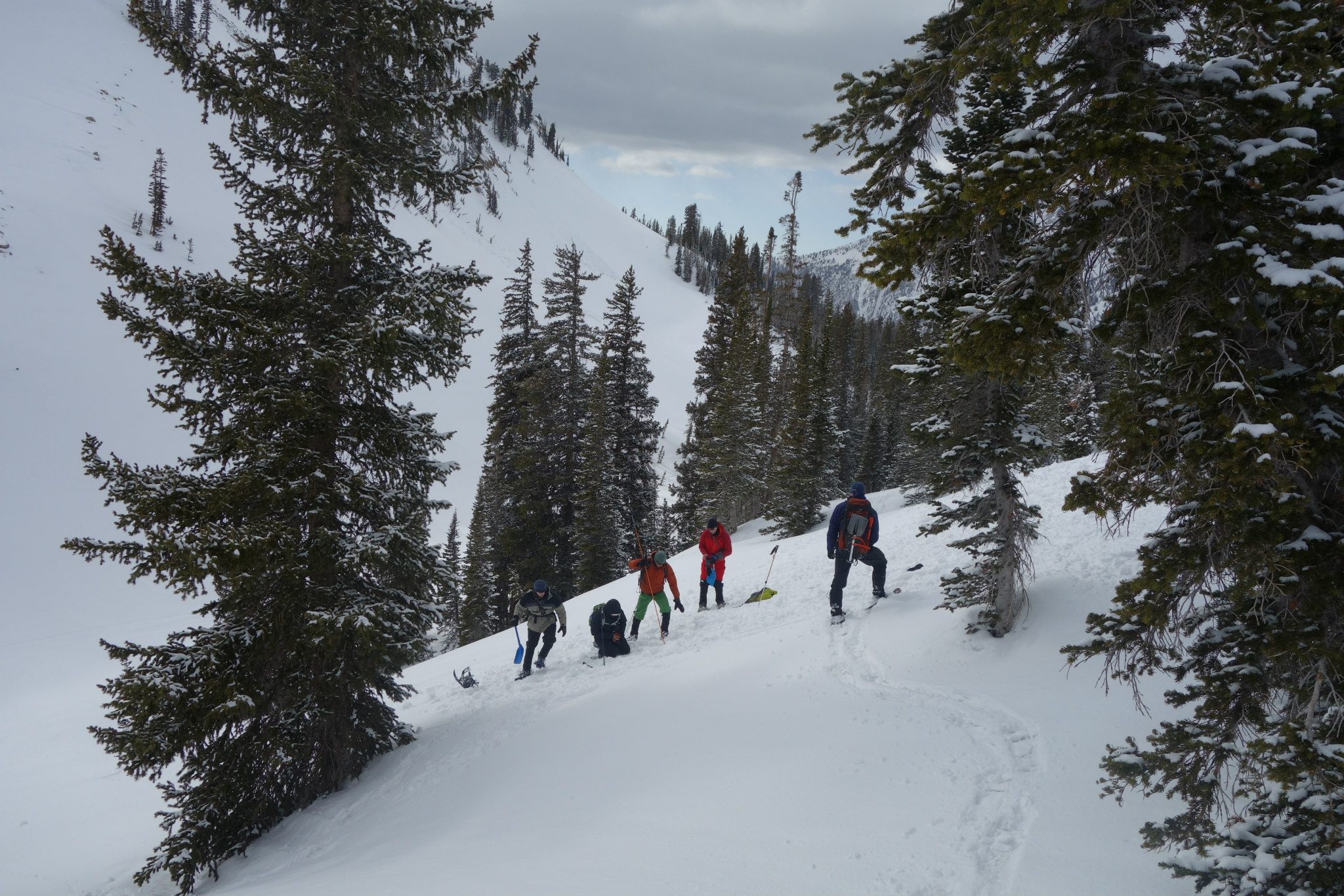
It's not what you would do in a hospital setting, but how do you get someone with a potential cervical-spine injury free after you’ve just dug them out of an avalanche slide? Stabilize their neck with their arms and drag them! (And kudos to our instructors.  Not only did they dig a deep snow cave for us to locate with avalanche beacons, but one of the brave residents agreed to be buried down there for one of our “scenarios”. I wish I could have seen the look on my face when we realized there was a person 5 feet under the snow!)

It’s not what you would do in a hospital setting, but how do you get someone with a potential cervical-spine injury free after you’ve dug them out of an avalanche slide? Stabilize their neck with their arms and drag them. (And kudos to our instructors. Not only did they dig a deep snow cave for us to locate with avalanche beacons, but one of the brave residents agreed to be buried down there for one of our “scenarios”. I wish I could have seen the look on our faces when we realized there was a person ~5 feet under the snow!)


The slope that we dug our patient out of- the instructors made the scenarios very realistic while keeping everyone safe.

The slope that we dug our patient out of- the instructors made the scenarios very realistic while keeping everyone safe.


Injuries in every settings... here I’m sporting a mid-humeral splint fashioned out of a camping chair (in the rain and on the river).

Injuries in every settings… here I’m sporting a mid-humeral splint fashioned out of a camping chair (in the rain and on the river).


A number of dermatologic conditions occur in the wild, so we discussed their various etiologies.  We also discussed methods of wound management, including wounds caused by snakebites, insect stings, and mammalian injury.  (On that note, during our time in the desert our group spotted rattlesnakes, scorpions, and a black widow spider.)


A trio of beasties spotted on our trip.

A trio of beasties spotted on our trip.


Many of the topics we covered are much more likely to be encountered in the wilderness than in a clinical setting, but some topics are ever-present in any setting.  Anaphylaxis and allergies can occur at any time, and while you may acquire tick-borne illnesses or infections diarrhea in the wild, the incubation time for many of these mean that they frequently present at a primary care office.  Nonetheless, these were topics we covered on this course, frequently harking back to the “bible” of wilderness medicine: Wilderness Medicine written by Paul Auerbach.


Thus far I’ve mainly focused on the didactic portion of the course, but much of the learning took place in “scenarios”.  I’ve never participated in simulation medicine, save for the standardized patients we get on our OSCE (Objective Structured Clinical Exam) at the end of most clerkships. While at first it can be awkward to “practice” medicine on people that you know are acting, once you get into the part it is a wonderful way to learn.


The beauty (and perhaps the terror?) of our scenarios was that our instructors would let us “play it out” in the field.  In clinical settings, while students may participate in discussions about patient care, they are never in the driving seat.  In our wilderness scenarios we were allowed to make the decisions and deal with the consequences.  At times this was frustrating (can’t I just ask the Wilderness Fellow standing over my shoulder what I should do), but it also allowed me to make mistakes that will stick with me for years to come.  For example, if a “helpful” stander by hands your patient some food, make sure they’re not allergic to it before they take a bite (that’s how a painful case of sun blindness can progress into life threatening anaphylaxis).


The scenarios also allowed (or I should say made) students make decisions about evacuation. Do we evacuate the patient? How? Can they walk? Do they need a litter? Do they need cervical-spine protection? Do we leave now or hunker down for the night and head out tomorrow? What’s the best evacuation route? Could a rescue team get a helicopter in here? A snowmobile? Maybe we should send runners to a ranger station? Where’s the closest location we can get cell phone reception?


The scenarios progressed with our wilderness medicine knowledge, as well as our knowledge of Incident Command Structure (ICS).  There were twelve medical students in our class, and when we had a scenario with one patient, it would be easy to have “too many cooks in the kitchen”.  On the other hand, when we had three patients, we could quickly run out of hands as people were relegated to “safety officer”, “equipment”, “communications”, and if the scenario necessitated it “runners” leaving the scene to make contact with civilization.


All in all, the medical education side of this course was excellent.  Some of the medicine was a review, but it was a much-needed review and one that frequently found we students (who are trained to practice medicine in well-stocked hospitals with multiple imaging modalities at our fingertips) asking “what do we have that we can use” and “how can we do what we need to get done”.


Medically, this class was a reminder of quite how much we’ve learned about medicine in the last few years.  It also emphasized that frequently there is no “right way” to handle a situation and your best guess and best efforts may save the day. We were also reminded of the reality that sometimes there is nothing you can do to save a life… and that is an important lesson to learn as well.


Not a bad place for a lecture...

Not a bad place for a lecture…

I’ve been hesitant to write this post.  This blog is certainly not a travel blog, and it was never intended to be a place where I posted my exciting travels (and to be honest, during the final years of my PhD and third year medical school I didn’t really have any exciting travels to write about).  That being said, I can’t help but post about my adventures in Moab.  If my antics encourage just one person to get outside and enjoy time in the great outdoors, I will consider this post a huge success…


Moab…

After completing my Wilderness Medicine Elective, I opted to take two weeks of vacation time (4th year medical students can get a rather absurd amount of vacation time if we play our cards right) to recoup, relax, and since I was already out west, spend time in Colorado with my best friend.  With over 100lbs of luggage to lug around, I managed to sweet talk my best friend into picking me up in Salt Lake City (where my elective wrapped up), instead of hopping a plane to Denver.


My best friend is a good sport about road trips (I suppose she should be, as I once drove 28hrs straight with her when she moved cross-country to Colorado), and she was happy to come pick me up, suggesting that we route our trip back through Moab for a bit of outdoor adventuring before heading back to Colorado.  I didn’t know much about Moab before I got there, but I knew Arches National Park was right next door and that the desert portion of my course was in Canyonlands National Park, so I thought it might be fun to swing back through and at least check out Arches on our way back.


That was before heading west… Once I met and talked with the river guides who work out of Moab and spent a “transition” day there between the river portion and the desert portion of the Wilderness Medicine elective, I was counting down the days until I would be back.


Moab is a stunning place- the rock formations and geology surrounding the town are truly “other worldy”, with the red rock shaped by time and weather into precarious and beautiful structures.  There is also a LOT to do in Moab for people who enjoy the outdoors.  The Colorado River can be enjoyed from rafts, boards, boats, or the shore, there seems to be a new hike for every day of the year, biking (mountain and road) is king, and the weather in May is wonderful for camping (sans-tent, for those-like myself- who are so inclined).


There are plenty of places to stay in Moab, but being on a budget and having spent the majority of the prior 3 weeks sleeping outdoors, I was more than happy to camp in Moab.  There are many campsites with RV hook ups, tent sites, and amenities such as showers, but I’m a fan of primitive camping.  Fortunately, for those in the know (or those who get the scoop from knowing river guides), there is plenty of dispersed camping to be had in spots around Moab.


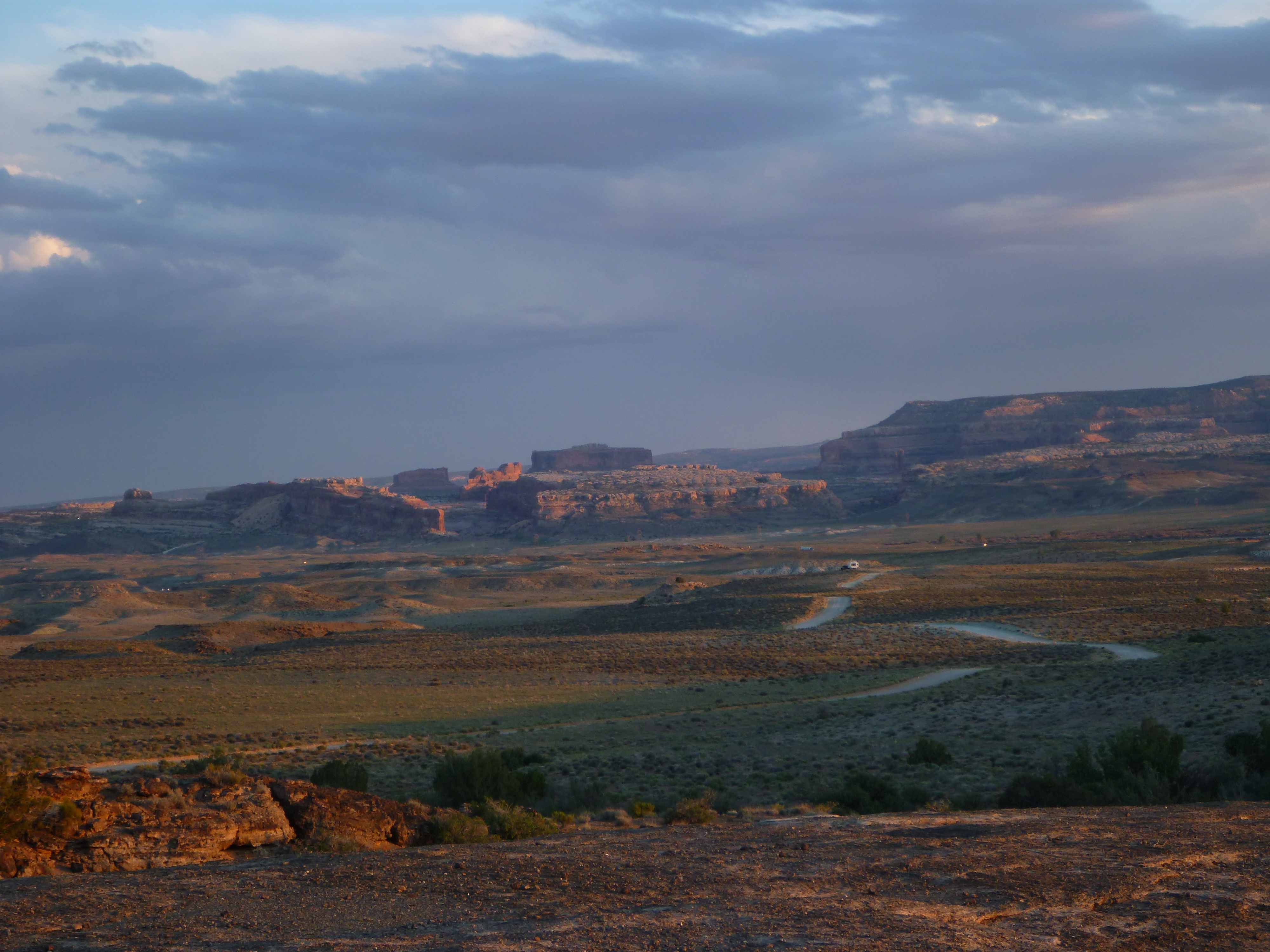
view from one of our camp sites up off Klondike Bluffs, about ten miles north of town.

The view from one of our camp sites up off Klondike Bluffs, about ten miles north of town.


We spent out first morning in Moab getting coffee (“That Paleo Guy”, Jamie Scott, would swoon at all the coffee spots in Moab) and sorting out plans for the next couple days.


Wicked Brew- home of a mighty fine shot of espresso

Wicked Brew- home of a mighty fine shot of espresso


After a morning in town we headed out for a hike at Fisher Towers.  This hike, while popular, is a bit off the beaten track (at least in comparison to the tourist heavy hikes in Arches National Park).  The rock formations are stunning and the plant life was beautiful. This place is popular for rock climbers, and it was breathtaking to see them atop the tallest towers.


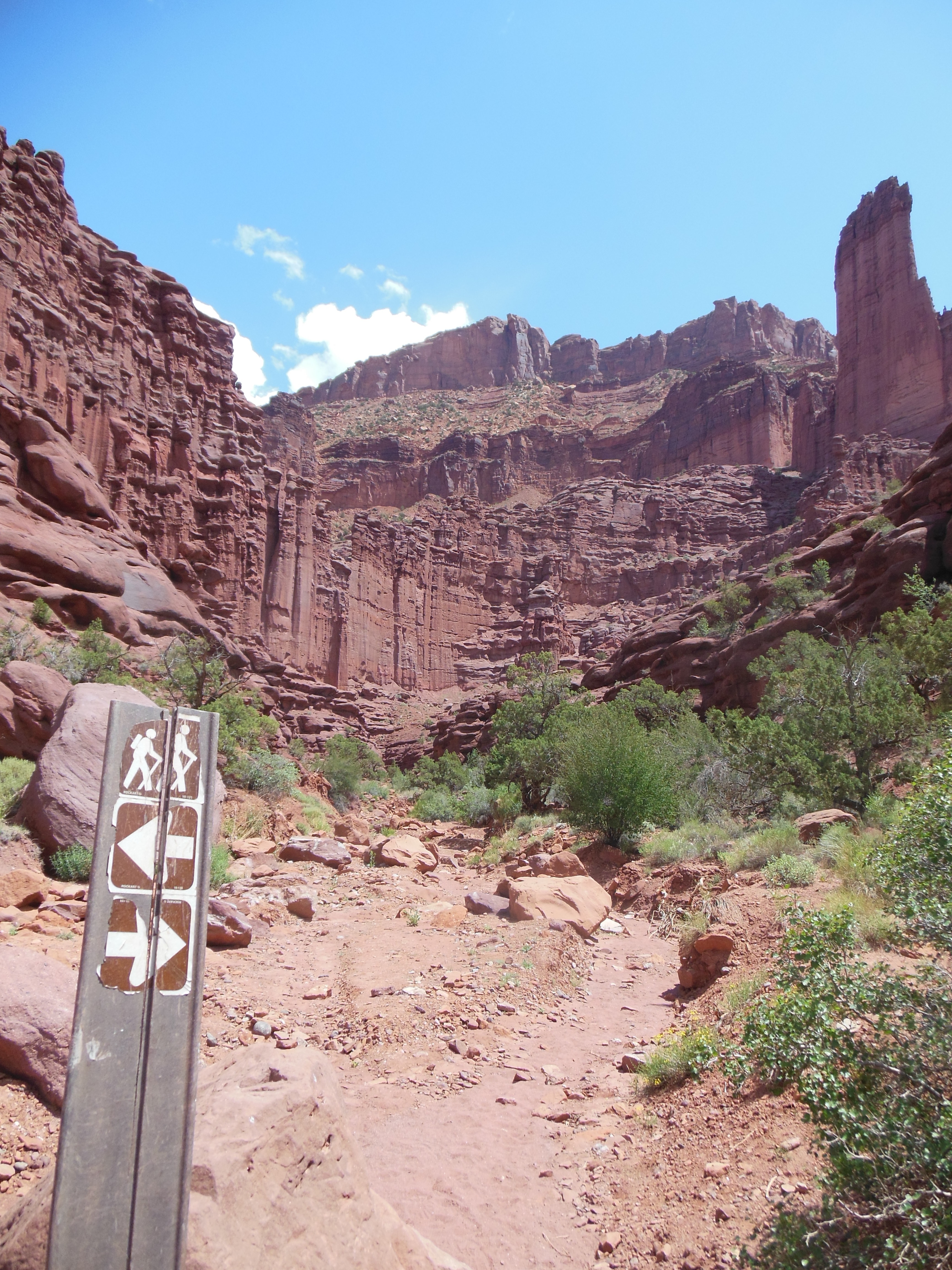
Fisher towers- if you go on this hike, make sure you get on the proper trail… we ended up scrambling quite a bit looking for a trail on various dead ends when we erroneously got started on a “photograph trail”.

Fisher towers- if you go on this hike, make sure you get on the proper trail… we ended up scrambling quite a bit looking for a trail on various dead ends when we erroneously got started on a “photograph trail”.


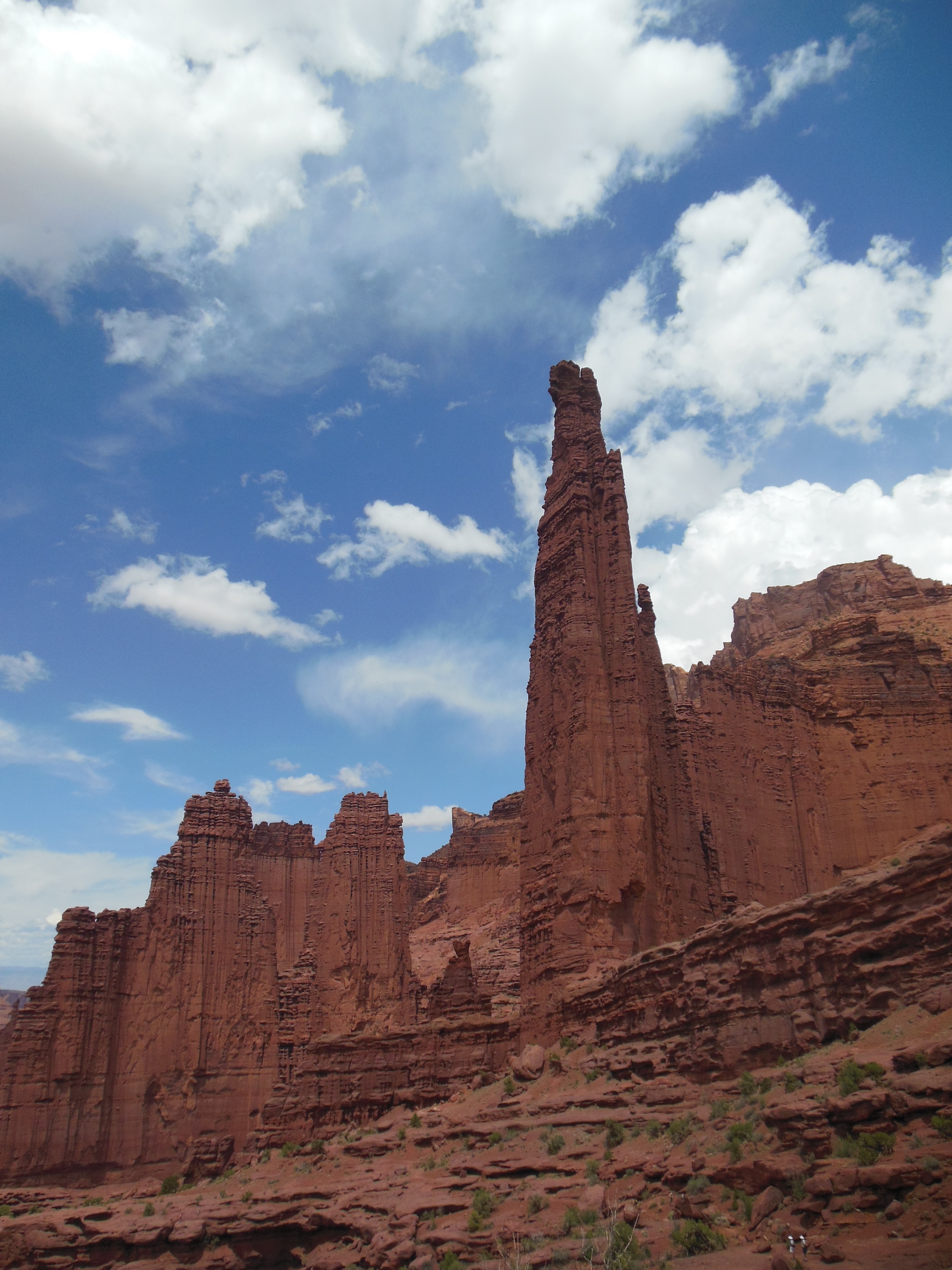
“The Titan” is the tallest structure at Fisher Towers, and is very striking.

“The Titan” is the tallest structure at Fisher Towers, and is very striking.


Alas, I seemed to have a knack for attracting rain on this trip… As we rounded the turn at the top of the hike, we were greeted by storm clouds and a flash of lightning.  Needless to say, we made a rapid retreat (I did learn about lightning strikes on my Wilderness Medicine course, but like almost all aspects of medicine, the best solution is prevention, prevention, prevention!)

Alas, I seemed to have a knack for attracting rain on this trip… As we rounded the turn at the top of the hike, we were greeted by storm clouds and a flash of lightning. Needless to say, we made a rapid retreat (I did learn about lightning strikes on my Wilderness Medicine course, but like almost all aspects of medicine, the best solution is prevention, prevention, prevention!).


After our hike, we headed back towards Moab, making one stop at a local vineyard and a detour down Onion Creek Road.  If you are around Moab and have an AWD vehicle (or are comfortable taking your vehicle through multiple stream fords), definitely check out Onion Creek Road.  If you’re really lucky, one of the dispersed camping sites might be open and available (we didn’t have any luck on that front).


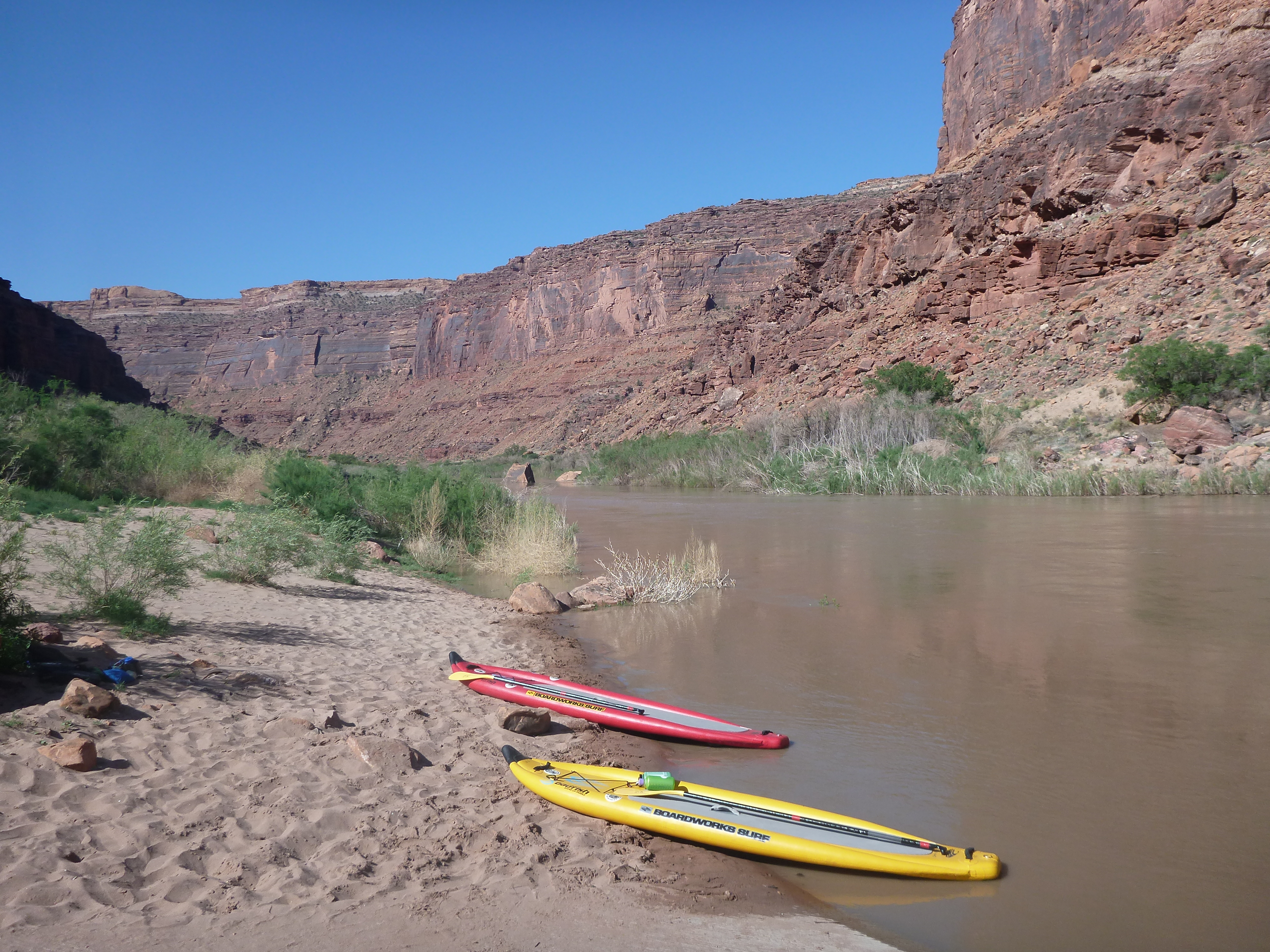
My best friend is an avid paddle boarder, and she’d contemplated packing her paddle boards down to Moab for us to use on the Colorado River.  It seemed that renting boards in Moab was a much better option, so after making some inquiries, we ended up renting two inflatable boards (Badfish MCIT) from Canyon Voyages, strapping then to our car, and driving them up river to our drop-in point.  We’d scouted the river the day before and had decided to drop in at Take-out beach and to get out at Lion’s Park: a ten-mile paddle downstream (with my friend opting for the hitchhikers shuttle after parking her car down at the pull-off site. Pro-tip: carry your PFD (personal flotation device) and catching a ride is pretty easy).


Boards- Ready for adventure.

Boards- Ready for adventure.


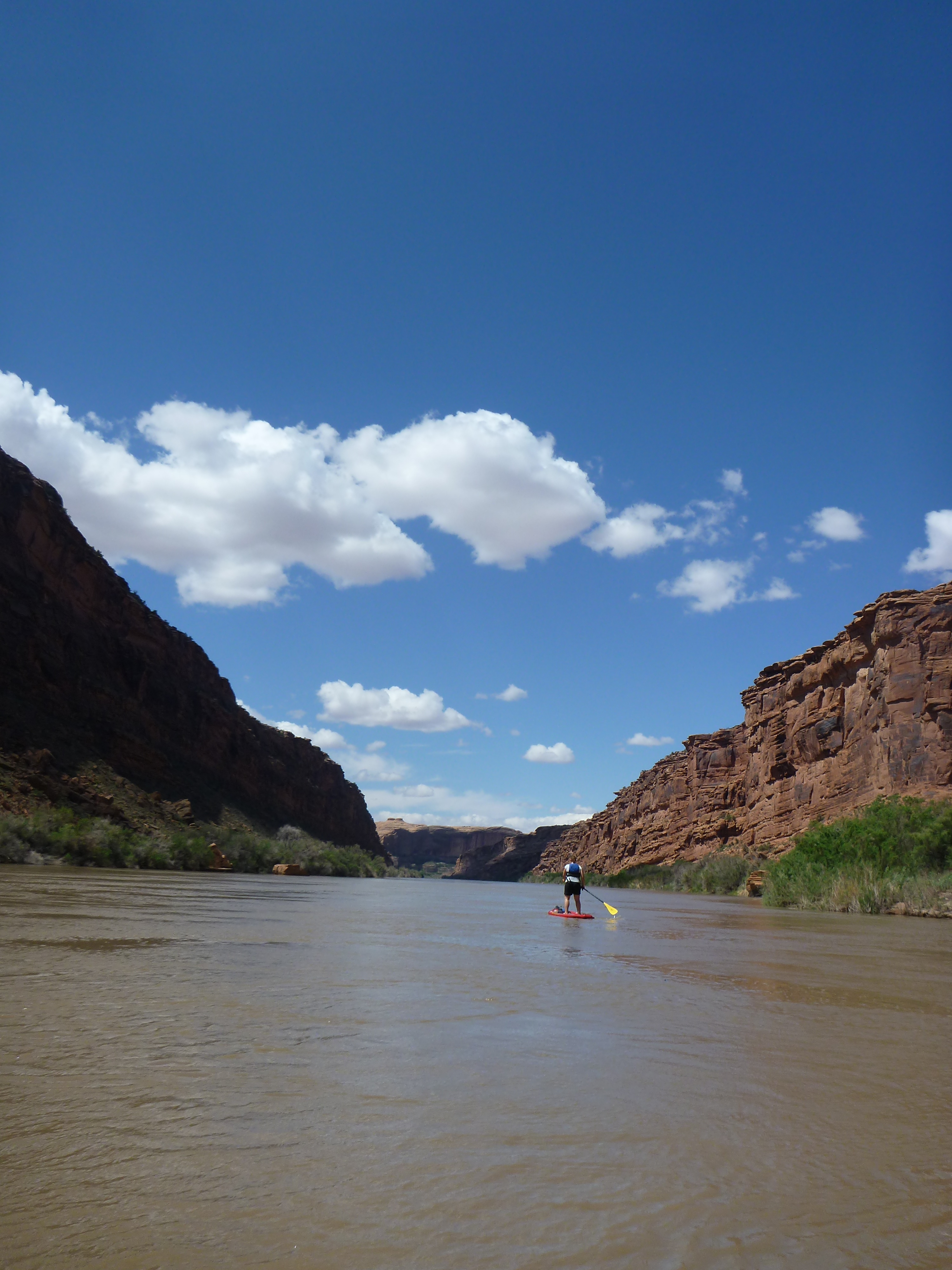
While a road parallels the Colorado River the length of our ten-mile paddle, the trip was still very calming.  I’ll be honest- I went through our lone rapids and a couple of the choppy fast-water sections firmly on my knees.

While a road parallels the Colorado River the length of our ten-mile paddle, the trip was still very calming. (Though I’ll be honest- I went through our lone rapids and a couple of the choppy fast-water sections firmly on my knees.)


The rest of our day was spent driving out to Dead Horse National Park, seeking out dinosaur footprints (yes really), cooking dinner at our campsite, and then meeting up with a new friend from my Wilderness Medicine Elective- one of the river guides from my travels down Desolation Canyon.


I can’t tell you if they’re Therapod or Sauropod footprints, but they were pretty cool!

I can’t tell you if they’re Therapod or Sauropod footprints, but they were pretty cool!


As much fun as the previous two days had been, the real adventures began when we started hanging out with a local… My river guide friend was just back from another long trip down Desolation Canyon, which meant that he had a bit of time off before heading back to the river.  The next morning he took us on a hike up to Cable Arch, an arch off the beaten track on an unmarked trail.  Our drive out to the trailhead took us past quite a few petroglyphs, including one that I found very interesting.


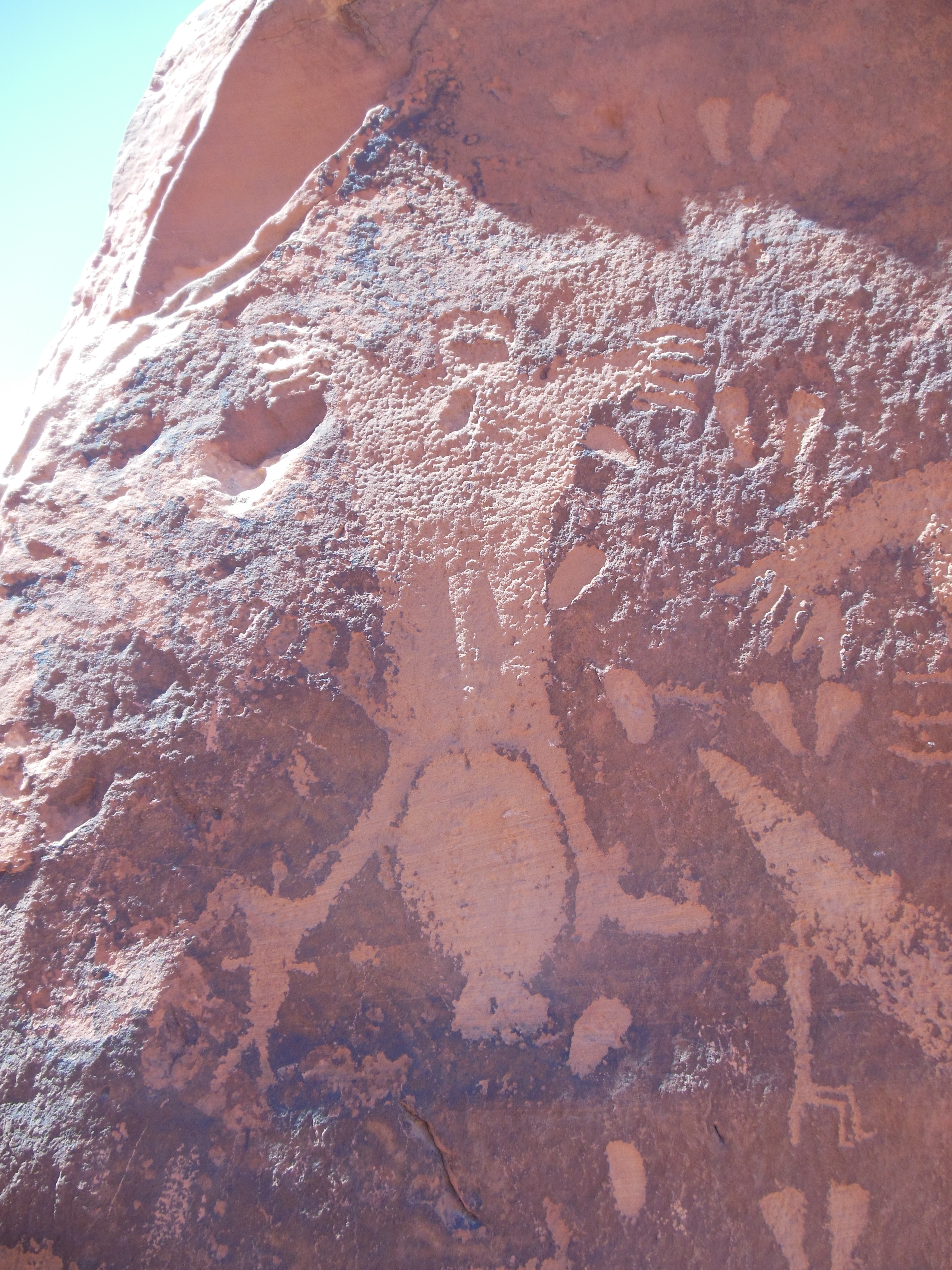
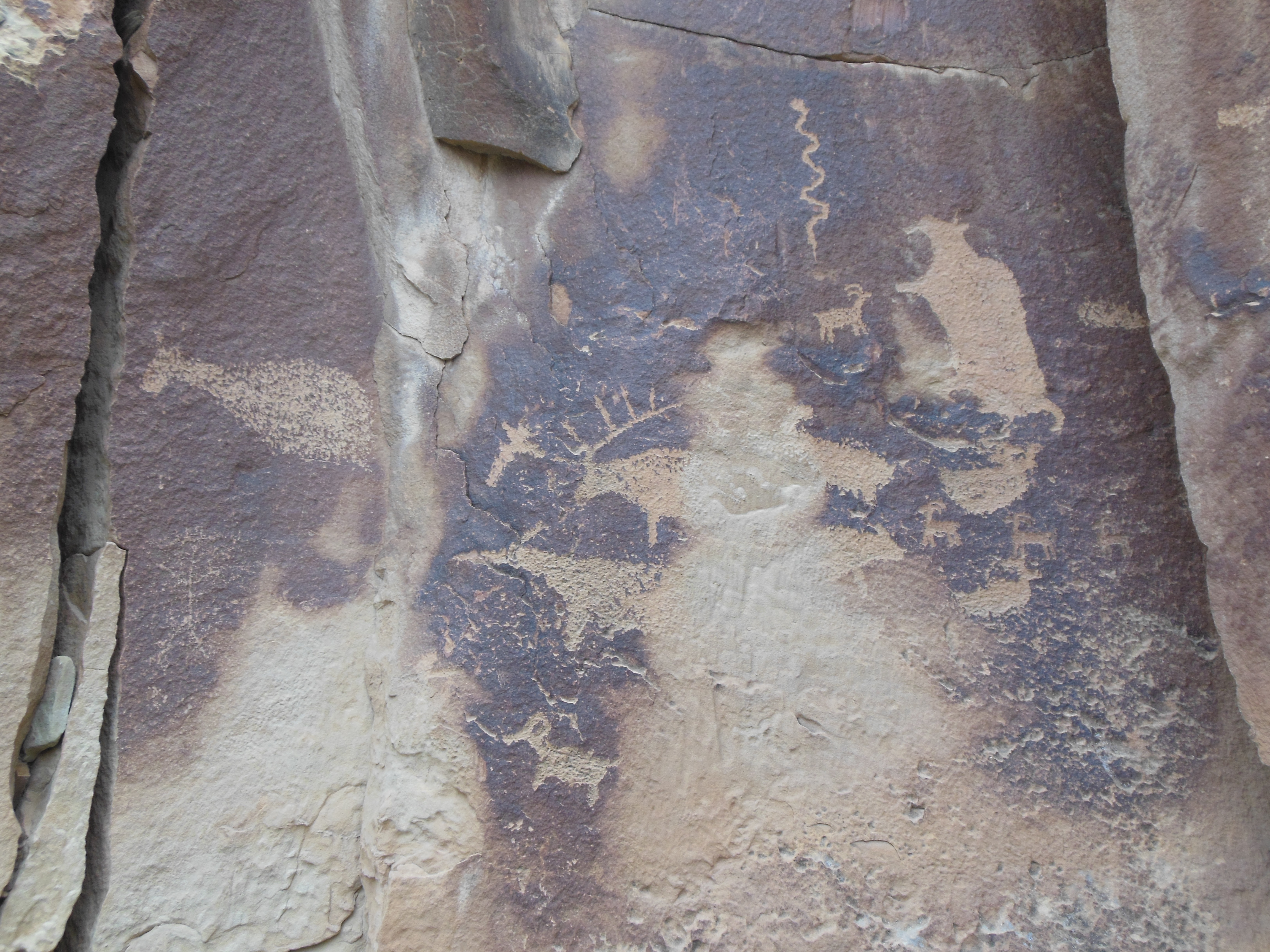
The birthing rock- my picture isn’t the best, but this petroglyph seems to show a breach position birth.  Some readers may remember that I’m interested in “traditional” positions for giving birth, so I found these depictions particularly interesting.

The birthing rock- my picture isn’t the best, but this petroglyph seems to show a breach position birth. Some readers may remember that I’m interested in “traditional” positions for giving birth, so I found these depictions particularly interesting. (Here’s a better picture.)


An arch all to ourselves… something you seldom get in Arches National Park

An arch all to ourselves… something you seldom get in Arches National Park


Not another person for miles...

Not another person for miles…


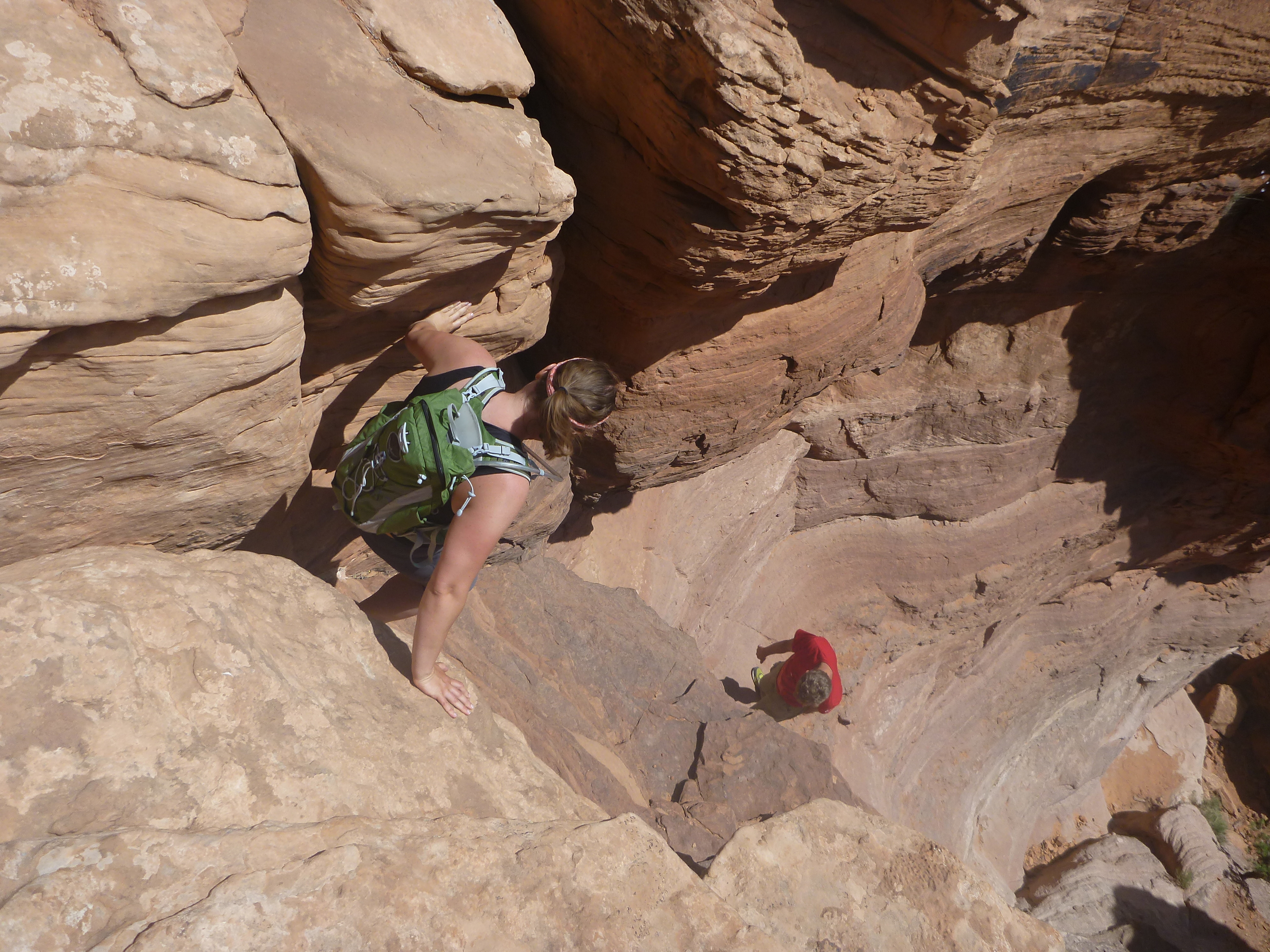
Scrambling up and down rock faces is a lot of fun (and an excellent work out)…

Scrambling up and down rock faces is a lot of fun (and an excellent work out)…


After a relaxing lunch in town, we headed up to the Sand Flats for an afternoon adventure of rappelling.  I’ve never been rappelling (save for the ~15’ rappel we played with up in the alpine on the Wilderness Medicine course), and I’ll admit that at the top of our first descent I was more than a little nervous.  However, as I lowered myself into the slot canyon (into an area aptly named “the medieval chamber”), my fear was replaced by exhilaration.


Rappelling down into the "Medieval Chamber".

Rappelling into the “Medieval Chamber”.


The second rappel, off a natural bridge, landed us at the focal point of a somewhat well travelled out-and-back hike.  My best friend went first, and her adventures were well documented by some of the sightseers below!


Kate, headed down off the natural bridge

Kate, headed down off the natural bridge

.

The next day found us rappelling again, this time in Arches National Park.  We were truly spoiled to have a local show us yet another awesome spot, for while we left our car in a crowded parking lot, we quickly backtracked along the road and scrambled up a rock fall to find ourselves isolated atop a large mesa.  Hundreds of feet above the other tourists below us, we spent much of the morning relaxing above Arches, in our own world, away from any other visitors to the park.


Above Arches- We spent quite a bit of time wandering around the top of the mesa, but eventually we settled down to soak up the sun, talk, and relax.

Above Arches- We spent quite a bit of time wandering around the top of the mesa, but eventually settled down to soak up the sun, talk, and relax.


Above Arches- I’m not sure the scale comes through…

Above Arches- I’m not sure the scale comes through…


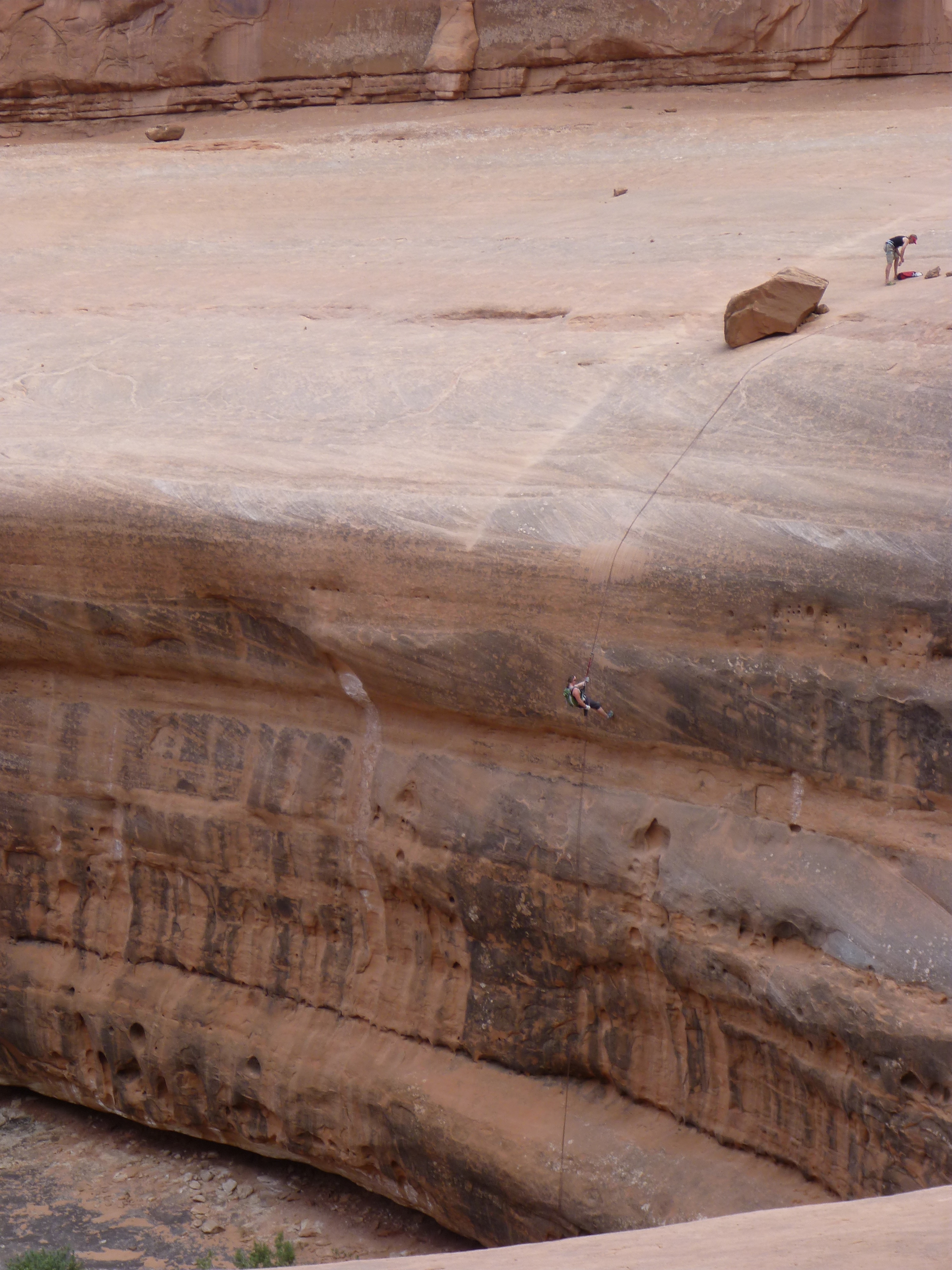
After an hour or so of basking on the rocks, we started our descent back down into the canyons.  This (again, unmarked) path took us down a number of small descents before finally putting us atop a 100’ wall down to the canyon floor.  The rappel was a rush.


Can you find me? Hopefully the scale comes through now!

Can you find me? Hopefully the scale comes through now!


My best friend and I did plenty of other things in Moab, including taking a drive and some hikes through Arches National Park. Arches IS stunning, but after getting an insiders-tour to some stunning and relatively unknown-to-tourists spots, hiking along crowded groomed trails to ogle at postcard views lacked some luster.  I don’t mean to sound snooty, and I hope it doesn’t come across that way, but I think my favorite moments of this trip to Moab were the moments with friends around bonfires, scrambling up rocks, and quietly taking in all that our surroundings have to offer.


After more than a month away, I am finally headed home to New Jersey.  I am heading home physically tired but psychologically refreshed.  I have always believed that nature is *good* for humanity, but I have never experienced this goodness so intensely as in the last month.


Through the wilderness medicine elective, my trip to Moab, and then a Memorial Day Weekend camping trip in the mountains of Colorado, I have experienced many different environments.  A big part of experiencing these environments, to me, is learning to be present in the moment- to quiet the mind of all the banality and drama that so easily catches us and to really appreciate what surrounds us.  In the hustle and bustle of normal life this skill takes practice, but it is practice that pays back in dividends on the principle that nature satisfies a deep and primal part of our humanity, and we should seek it out and absorb it whenever possible.


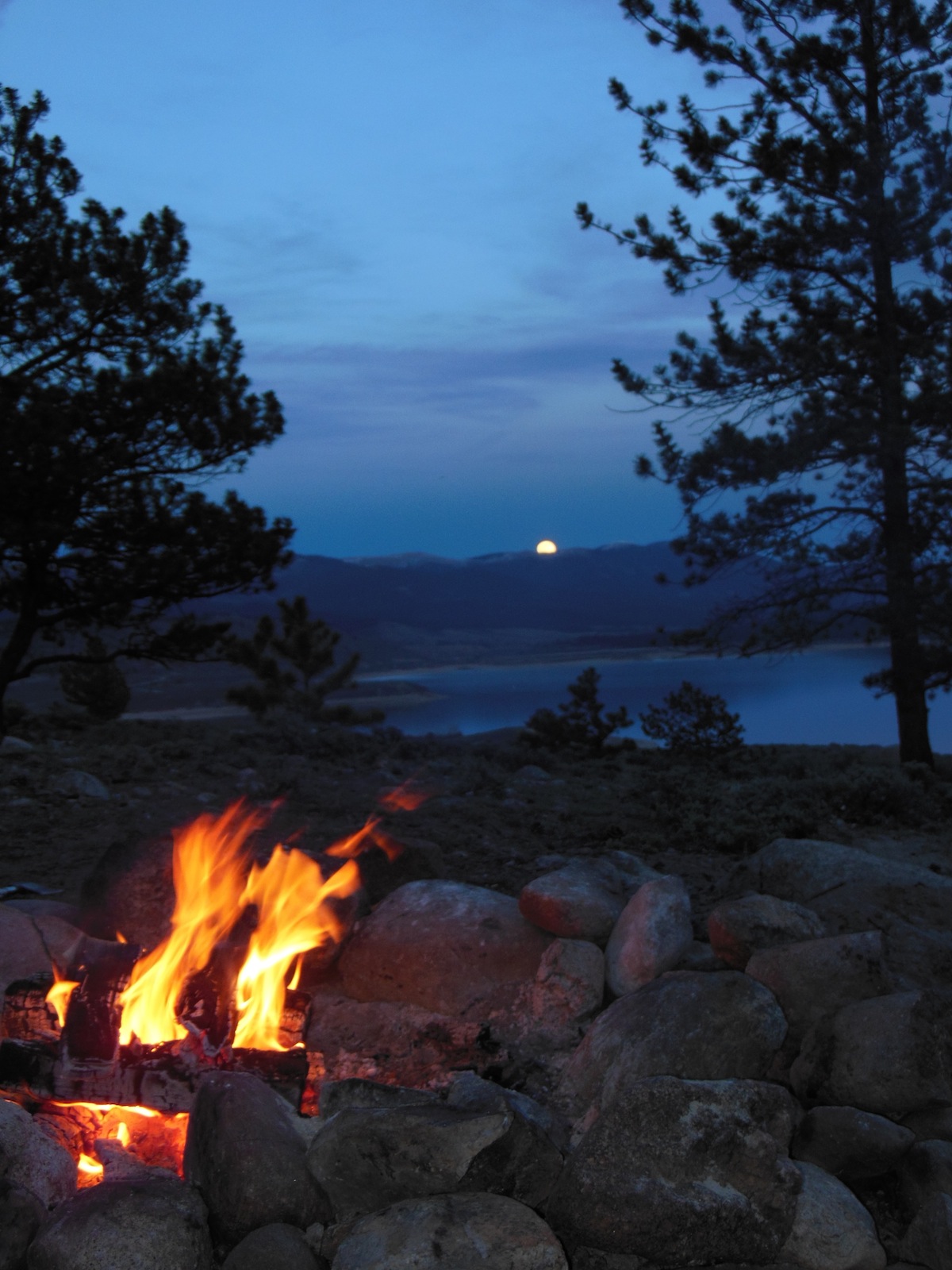
Memorial Day Moonrise over Twin Lakes in Colorado- Not sure I can think of a better way to end the day…

Memorial Day Moonrise over Twin Lakes in Colorado- Not sure I can think of a better way to end the day…


Find your people, find your places, and enjoy the moment…

I have spent only 5 of the last 25 nights in a bed (4 different beds, to be precise). At this point I feel a touch claustrophobic in bathrooms and feeling clean is certainly a novelty.  My Wilderness Medicine elective is over and I have had an exceptional visit in Moab (more on that in another post). Tomorrow I head to the mountains of Colorado for one last stint in the wilderness before heading back to New Jersey where I will start a radiology elective on June 3rd.  From a month in the wilderness to an elective spent in dark, windowless rooms- the change in environment couldn’t get much more extreme (which is saying a lot, coming from someone who has gone from alpine camping to desert camping in the course of 3 weeks).


This is the final installment of “Pic of the Day”, at least for the Wilderness Medicine Elective.  I may not be able to resist a “Pic of the Day, Moab edition”… we shall see.


For the desert portion of the course we headed to Canyonlands National Park, specifically The Needles District of the park.  We spent 4 nights in 3 different sites, hiking up to 12 miles a day with heavy packs.  I found this portion of the course the most physically demanding, but at the end of the day it was unquestionably my favorite section.


I’ll write details in future posts, but for now: Pic of the day- desert edition.


Day 1- Canyonlands


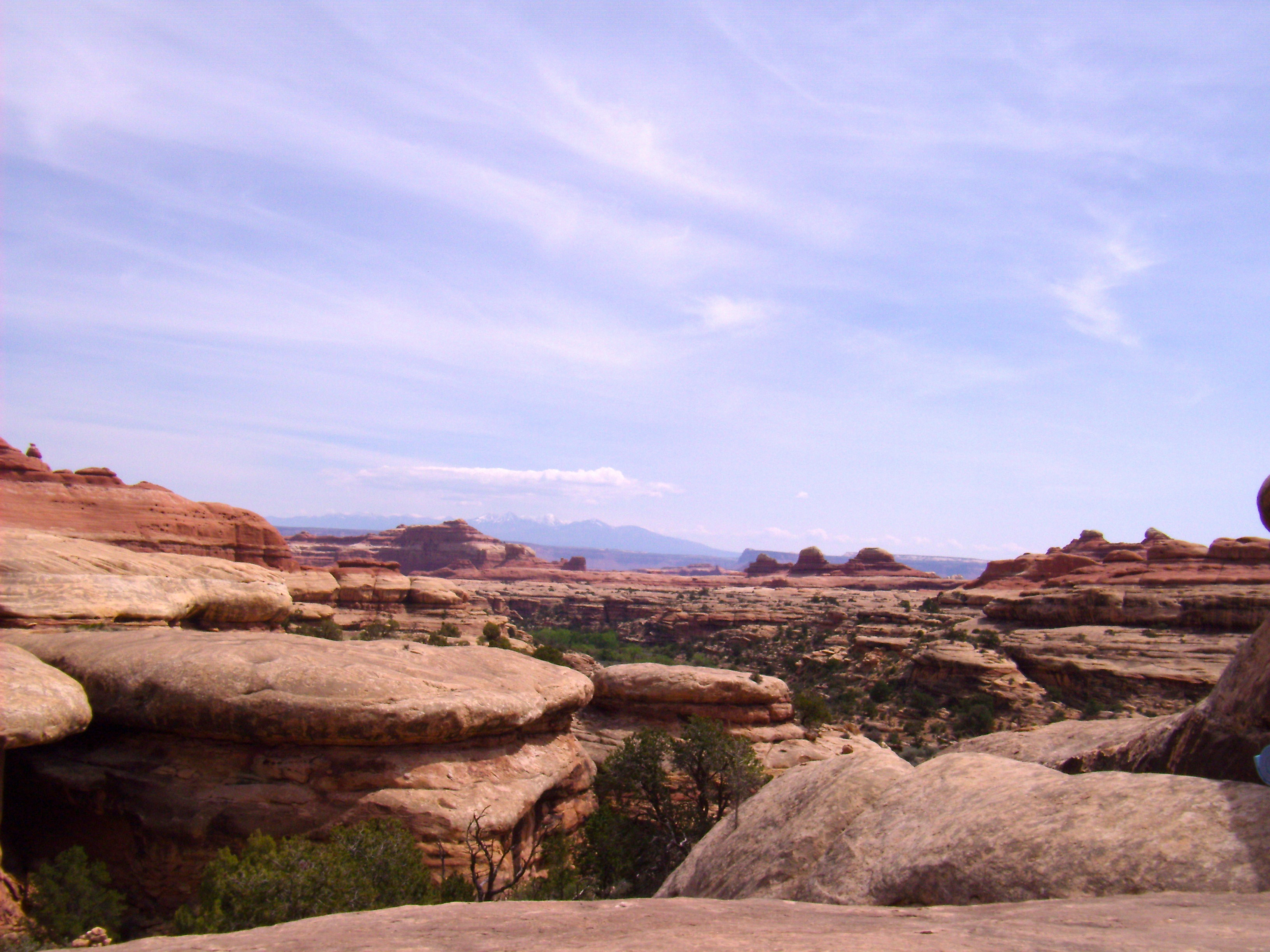
The geology of Canyonlands (actually, the geology of much of Utah) is stunning and fascinating.  This is in the needles are, near Lost Canyon, where we spent our first night in the park.

The geology of Canyonlands (actually, the geology of much of Utah) is stunning and fascinating. This is in the Needles District, near Lost Canyon, where we spent our first night in the park.


Day 2- Perspective


Looking back at Lost Canyon as we hike out to Elephant Canyon, our next campsite. From many vantage points in the park you could see the snow capped La Sal Mountains.

Looking back at Lost Canyon as we hike out to Elephant Canyon, our next campsite. From many vantage points in the park you could see the snow capped La Sal Mountains in the distance.


Day 3- Druid Arch.


Before we packed hiked our big packs out to Chesler Park, we took an early morning park out to Druid Arch.

Before we hiked our big packs out to Chesler Park, we took an early morning hike out to Druid Arch.


Day 4- The Joint Trail


Probably one of the coolest trails I have every hiked, winding through a narrow slot canyon.

One of the coolest trails I have every hiked, The Joint Trail winds through a narrow slot canyon.


Day 5- Sunrise and out.


We left camp at 4am for the 3+ hour hike out.  I led the group of 19 by head lantern for 2 hours before stopping on a bluff to watch the sun rise around 6am.  Pre-dawn hikes are something I will be adding to my repertoire.

We left camp at 4am for the 3+ hour hike out. I led the group of 19 by head lamp for 2 hours before stopping on a bluff to watch the sun rise around 6am. Pre-dawn hikes are something I will be adding to my repertoire.


I did not expect to fall in love on this trip, but I have certainly fallen in love with the desert.  I don’t know when I’ll be back, but I hope it is soon…


Chesler Park.


Chesler Park

My Wilderness Medicine elective has officially come to a close. In the last three weeks I’ve experienced three very different environments (alpine, river, and desert) and learned lots of pre-hospital medical care for emergencies that arise in the wilderness.  I have quite a bit to write about, but I liked doing a “pic of the day” for the alpine session, so before I get to a thorough write up of the course I’ll post a “pic of the day” for the river and desert portions.


While the course is over, my adventure hasn’t come to an end.  I’m currently taking 2 weeks of vacation time to visit with my best friend, first spending more time in Utah in and around Moab and then heading back to her home in Boulder Colorado.  I hope to get some good writing in during this time… we shall see!


Without further ado- “pic of the day” river style!


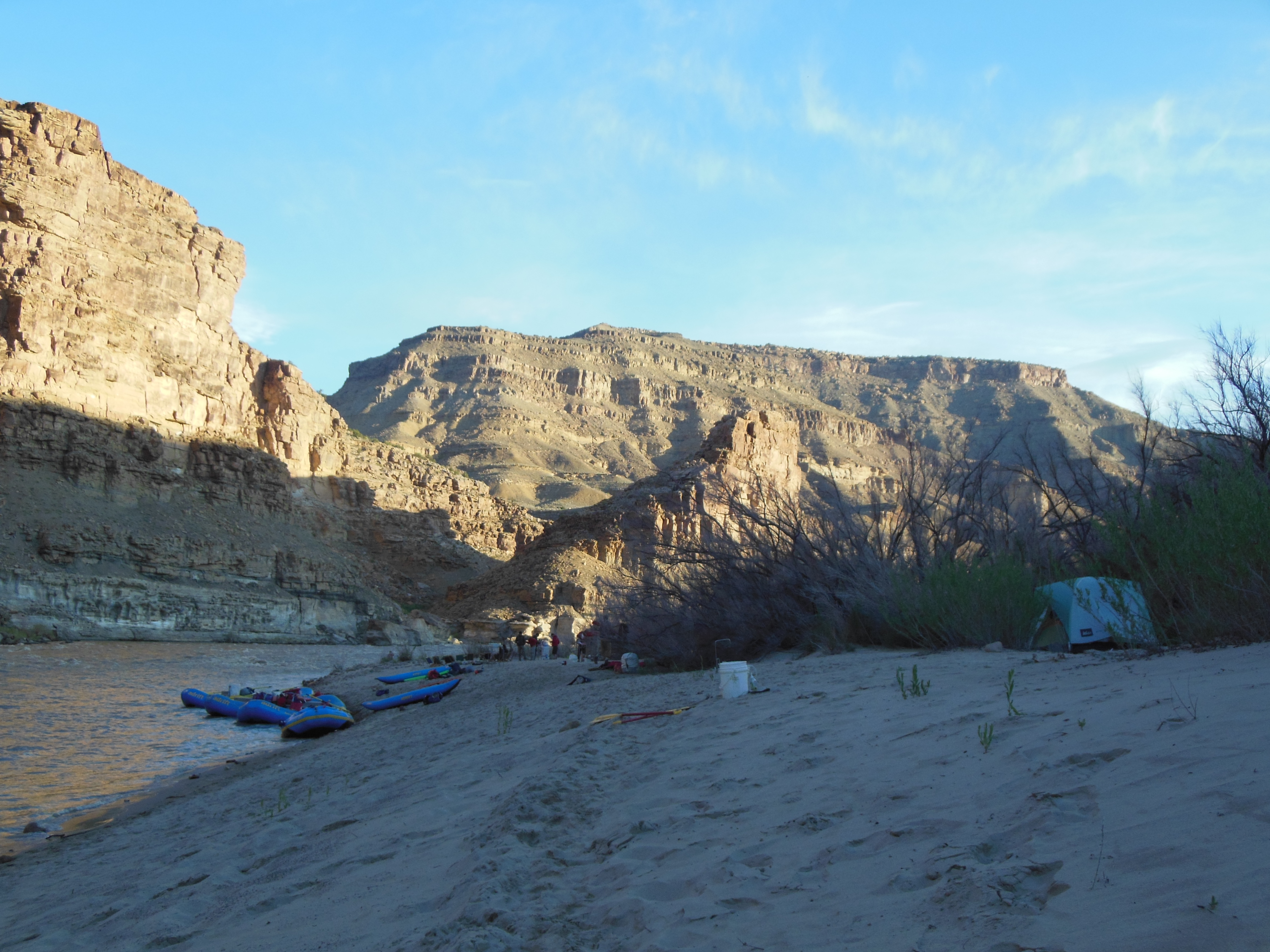
Day 1- We started our adventure at the Sand Wash put in on the Green River where we camped, sans-tent, under the stars…


Camping under the stars.

Camping under the stars.


Day 2- Over the next 5 days we travelled ~87 miles down the Green River, passing through Desolation Canyon and Gray Canyon.  We saw a few different areas with petroglyphs, presumed to be from Fremont people.


Petroglyphs carved into "desert varnish", which according to the river guides (and wikipedia) is at least partially made of manganese.

Petroglyphs carved into “desert varnish”, which according to the river guides (and wikipedia) is at least partially made of manganese.


Day 3- Sun rising on the cliffs of Desolation Canyon.  This pic is a bit deceiving, as we actually had more “bad” weather than good.  I suppose we should consider ourselves lucky that we got to experience rain in the desert, but getting hammered with more than a third of the area’s average annual rainfall over 4 days could get a bit demoralizing!


A great view by which to enjoy your morning coffee...

The morning view from our campground. A great view by which to enjoy your morning coffee…


Day 4- Please allow me two pics for this day- I couldn’t chose just one (it would be easy to pick a gorgeous landscape for each day, but there really was a lot more to see).


The view from another campground...

The view from another campground…


Equipment at an abandoned ranch. During our float down the river we saw abandoned ranches, old mines, and even an old moonshine distillery.

Equipment at an abandoned ranch. During our float down the river we saw abandoned ranches, old mines, and even an old moonshine distillery.


Day 5- At the end of the day we would gather around a fire recapping the day, telling jokes, and marveling at where we were.  Off the grid, without technology or the distraction of modern society, it was wonderful to decompress.


Social gathering place and hot spot for heating evening beverages.

Social gathering place and hot spot for heating evening beverages.


Day 6- Our last day of camp was spent just below Rattle Snake Rapids (I loved going to sleep to the sound of rapids).  We were pampered on this portion of the trip, being taken care of by river guides- renaissance men of the modern age.  They’re guides, chefs, handymen, naturalists, historians, and fascinating individuals… I hope to reconnect with some when I return to Moab.


The nomadic life, with a new campground each night, was great- especially when gear was being floated down the river and not packed on our back!

The nomadic life, with a new campground each night, was great- especially when gear was being floated down the river and not packed on our back!


I’ll post some pics from the desert section when I get a chance!


——-


And for the skeptics, who question whether there was any medical learning on this trip…

I’ll write more on the medical learning in a future post, but here you can see me rocking an improvised humeral fracture splint… in a torrential downpour (thank goodness for Gortex!)

I’ll write more on the medical learning in a future post, but here you can see me rocking an improvised humeral splint… in a torrential downpour (thank goodness for Gortex!)


If you read my last post, you’ll know that I’m currently away in Utah on a Wilderness Medicine elective.  I’ve just come back from the first evolution, the alpine section, and have one night in Salt Lake City before hitting the road tomorrow morning to head to the Green River and Desolation Canyon to take on the next portion of the course.


I certainly don’t have time for a thorough write-up of the last week, but I thought I’d give a quick “pic of the day” from the last week to give you an idea of what I’ve been up to.  The pics certainly can’t show all the learning that’s been going on- while there is certainly a large component of this course that many would consider recreation, I think I’ve learned more practical medical skills in the last week than I have in quite some time.  Sure- I don’t know when I’ll next be using an avalanche beacon or when I’ll next use an ice axe to “self arrest“on the side of a cliff, but the skills of dealing with medical emergencies is non-hospital settings and with limited means is certainly important.


Without further ado (and because I don’t have much time…)


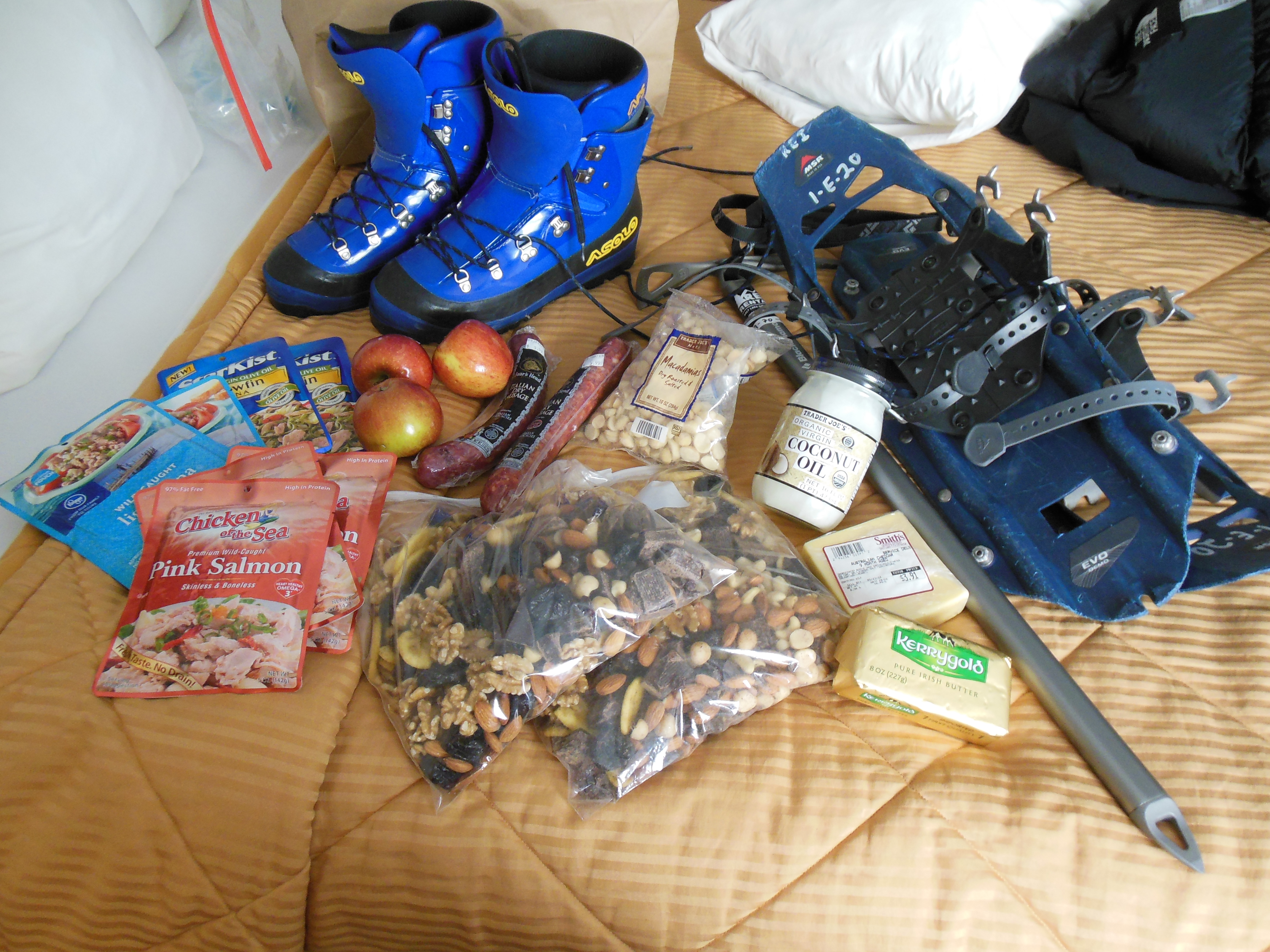
T-minus 1 day… I went shopping.  I knew I wouldn’t be enthusiastic about much of the food available on our trip, so I packed a significant personal stash to keep me going (I ate more nuts in the last week than I have in the last few months).  I also rented double plastic boots, snowshoes, and an ice axe from REI.


Yes- I packed a stick of butter and a jar of coconut oil up the mountain... And if I never eat cold, unseasoned, packages of salmon again, it will be too soon

Yes- I packed a stick of butter and a jar of coconut oil up the mountain… And if I never eat cold, unseasoned packages of salmon again, it will be too soon


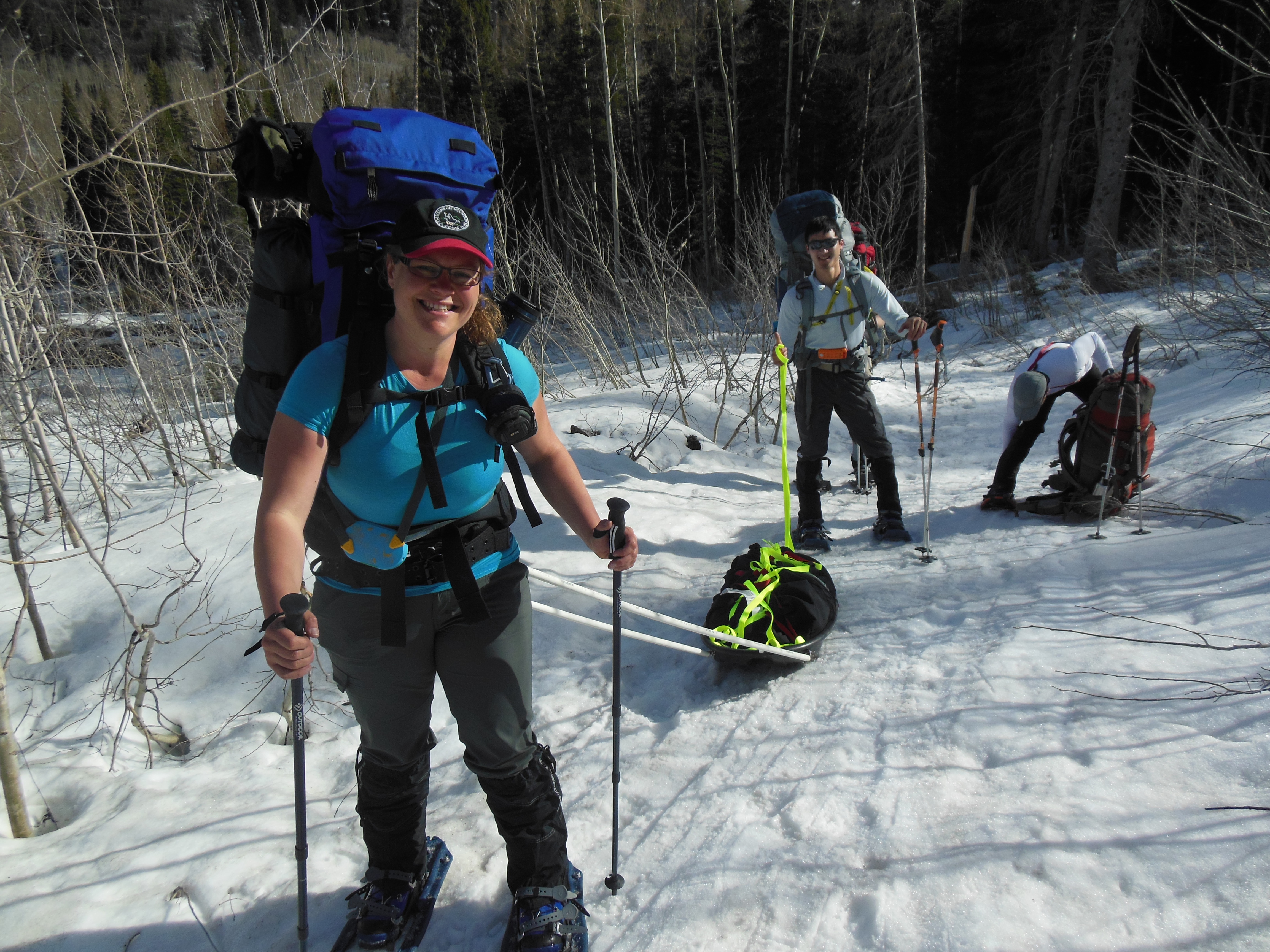
Day 1- The hike up.  I’ve never hiked in snowshoes with a big pack before, so why not add in dragging a loaded sled to the process! Our group of 20 (12 students, 4 residents, 2 fellows, and 2 attendings) hiked up to our site near Lower Red Pine Lake in the Wasatch Mountains.

Wool was definitely my friend on this trip, starting on day 1. Can you spot the avalanche beacon I'm wearing?

Can you spot the avalanche beacons?


Day 2- Water. Our group was broken into 4 teams of students and residents, and each day we had different tasks. On our second day my team was in charge of water, which we filtered from this lake.

It is incredibly peaceful out on the lake pumping water (at least when it was warm enough the water didn't freeze within minutes in the tubing.

It is incredibly peaceful out on the lake pumping water (at least when it was warm enough that the water didn’t freeze almost instantly in the tubing).


Day 3- Snow.  Yeah… this happened. A good 6” of “dust on crust”.

Fresh pow

Fresh pow


Day 4- Home. This tent was my home for 6 days. I shared it with two other medical students, and with overnight temps dipping  into the teens (F) I got very familiar with the workings of my 0o mummy bag.


Our camp was quite impressive- 7 tents, a double kiva with dug out benches and tables beneath, and a kitchen dug into the snow pack.

Our camp was quite impressive- 7 tents, a double kiva with dug out benches and tables beneath, and a kitchen dug into the snow pack.


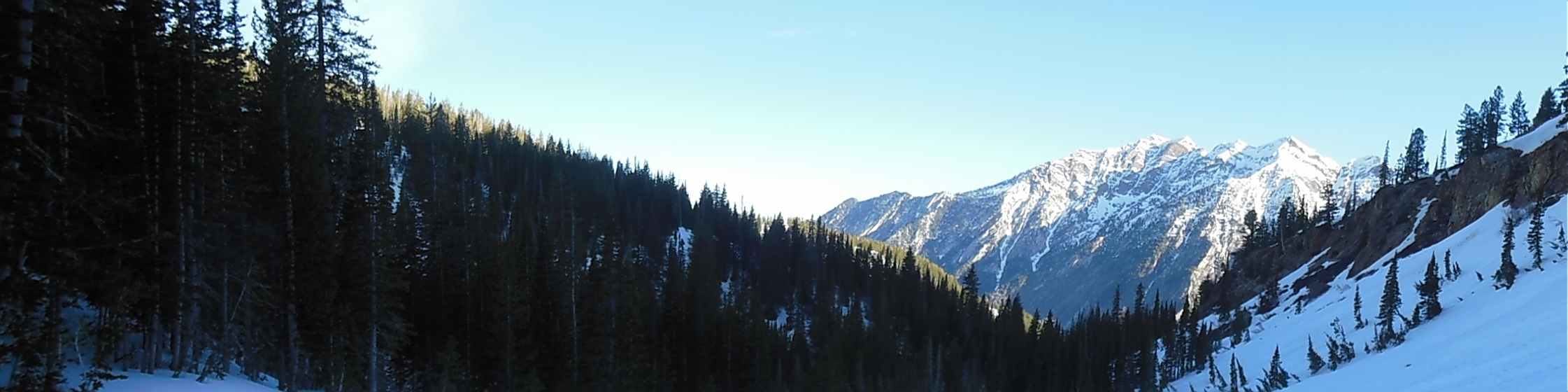
Day 5- Hike day. On our last full day we hiked up to the ridge leading to the false summit of Pfeifferhorn. The views were stunning.

View


Day 6- Out.  This morning we woke at 6 to pack camp and head back to civilization.  My feet won’t miss the heavy double-plastic boots, but I will definitely miss these mountains.

Out


I plan to write more about the actual medical aspects of this course, but for now I hope you enjoy these pics!


And for those that see the t-shirt picture and think this was a warm-weather hike, this is how I was dressed most mornings in camp.  


Cold

No- this isn’t another post about books (though I did enjoy the book of this title by Jon Krakauer and I love the soundtrack by Eddie Vedder).  Rather- I wanted to let you all know what I will be up to for the next few weeks.


Wilderness Medicine is, well, kind of what it sounds like- providing acute medical care in various outdoor environments.  Being an outdoor person, this was an area of medicine I’ve been rather interested in exploring.  My school doesn’t offer a Wilderness Medicine elective but many schools do, and they generally welcome students from other schools.


A number of months ago I set to, looking at a number of Wilderness Medicine electives offered by other schools and organizations.  There are quite a few options, but one, run my U Mass, really caught my eye.


I should interject at this point to say that, due to the timing of my PhD defence, I started the clinical years of medical school half a year off schedule with most students. Unfortunately, that meant that when I started looking at wilderness electives, I was a bit behind the eight-ball timing wise.


A number of months ago I sent an e-mail to the organizers of the U Mass Wilderness Medicine elective enquiring if they took students from other schools.  They replied, kindly informing that they did but that the course usually fills up a year in advance (and it runs from the end of April for three weeks).  Somewhat disappointed, I set up my schedule for the remainder of fourth-year medical school, sans wilderness medicine elective.


Fast forward to three and a half weeks ago when, out of the blue, I got an e-mail from the program coordinator asking me if I was still interested in the Wilderness Medicine elective.  After some frantic shuffling of my schedule I was able to say yes, and have been hustling to get myself prepared ever since.


Bags are packed and I'm ready to go (both under 50lbs, though I'm getting close).

Bags are packed and I’m ready to go (both under 50lbs, though I’m getting close).


Tomorrow morning I leave New Jersey to head to Salt Lake City (and to think- I was there less than 3 months ago).  After spending a couple days meeting up with friends and seeing the sights of SLC, I meet up with the students, residents, fellows, and faculty who will be participating in the Wilderness Medicine elective.


The main reason I was particularly interested in the U Mass elective was because it is a 3 week elective taught almost exclusively IN the wilderness (unlike some other programs that do a lot of classroom-based learning and then have excursions into remote areas).


The elective is broken up into 3 components, an alpine section, a river section, and finally a desert section.  In each we receive faculty taught lectures, participate in scenarios, and hear (and give) student lectures (my topic is diarrhea and communicable diseases).  I’ll write more when I return, but this is what I know for now.


The alpine section


We head up into the Wasatch Mountain range where we set up a base camp that we will be living in for the next 6 days.  We snowshoe in with all our gear (apparently about 50lbs in our packs, plus pulling sleds, and then camp on snow for the next 5 nights.  Here we learn how to live in the alpine environment, the basics of mountaineering, avalanche training, how to lift and move patients with spinal injuries, as well as attend lectures on topics relevant to the alpine environment.


The river section


After snowshoeing out of the mountains we have a day to recover in Salt Lake City before heading to the Green River for the river section of the course.  Over the next 5 days we raft down the river (camping on the banks each night) and learn about water-associated injuries (drowning, of course), as well as other injuries and illnesses that occur in the bush, including fractures (and improvised splints), dislocations, wilderness dermatology, mammalian injuries, and evacuations.


After a transition day in Moab (where we can apparently opt to participate in outdoor activities of our choice, or perhaps enjoy a needed day of R&R), we then head to the desert portion of our course.


The desert section


Having had a chance to check out Moab, we head to Canyonlands National Park.  Here, we hike into the desert (in smaller groups, so as to decrease our impact), and set up camp for 4 days.  We meet daily for lectures on topics such as snakebites, heat illness and injuries, communicable diseases, wilderness toxicology, and other relevant topics while also learning skills such as orienteering and mass casualty training.


Throughout the course, in addition to many lectures, we participate in 12 “scenarios” which further train us for practicing medicine in the wild.  There will be 12 medical students, 4 residents, and 2 Wilderness Medicine fellows, as well as faculty.


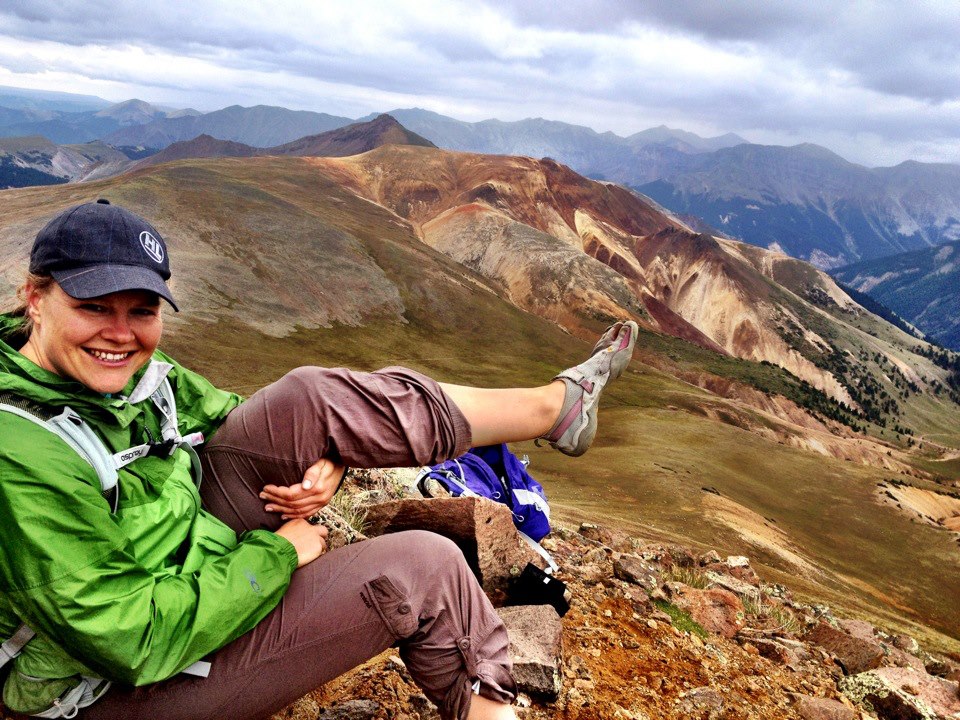
I’ll be interested to see what happens when it comes to camp dinners.  They asked if anyone had “dietary restrictions”, with a special shout-out to vegetarians.  While I’ll be willing to eat things that I usually don’t consume (rice and beans, for example), I really hope I’ll be able to largely avoid processed foods, grains, and vegetable oils… we shall see.  I’m also a little nervous that I’ll get some foul looks for my choice of footwear.  The packing list suggests bringing hiking boots (or maybe hiking shoes) for the desert and river portion: I have neither, and imagine that trying to get some and break them in would not be a good idea (not to mention that I am kind of opposed to thick soled heavy hiking boots). Instead, I have my minimalist trail running shoes and my vibrams… I’ve climbed a 13er in Colorado with them, hopefully I can hack it carrying a heavy pack!


Up Matterhorn in Colorado, happy in my VFFs.

Up Matterhorn in Colorado, happy in my VFFs.


So there you have it- starting Monday morning (maybe sooner) I’ll be off the radar for large chunks of time (though you wouldn’t know I was on the radar with the frequency of my blog posts).  When the course is done, my best friend will be picking me up in SLC and I’ll be heading back with her to Colorado for a vacation before coming home to start a radiology elective in June.  On the way back to Colorado we plan to spend a couple days in Arches National Park- since I’m sure my appetite for the outdoors won’t yet be sated.


More posts to come!

A few months ago I did a two-week elective with our hospital’s Emergency Medical Services. Over those two weeks I saw all manner of medical “emergencies”.  Some were true emergencies, but plenty were BS calls where first responders and ambulances were called into action when what was really needed was an $8 taxi ride to the emergency room (or even better, $8 worth of broth and a couple days in bed to get over the flu, but I digress).


I met some wonderful first responders on this rotation. People that really want to help others and who obviously get a high from the adrenaline of being called to duty in an emergency.  As I saw bits of the recent Boston and Texas events unfold I imagined how the EMTs and medics I worked with would have jumped to duty in these situations.  Indeed, many of them did 11.5 years ago when they responded to the attacks on the World Trade Centers.  One of the women I worked with lost a friend who was responding that day.


Unlike the hospital environment, where people usually avoid any controversial conversations, I frequently found the topics of religion, politics, taxation, healthcare reform, and gun-control being discussed. The disagreement was sometimes vehement, and the conversations often heated, but there were never any hard feelings at the end of the day.


I worked with a number of EMTs and medics on my 2-week elective, but I bonded with one in particular. I think we had matching (or perhaps complementary) streaks of cynicism and optimism (yes, you can be both a cynic and an optimist. In my case, I think my cynicism protects my optimism from being snuffed out by reality).  He asked if I had read The House of God [1], by Samuel Shem, (the nom de plume of psychiatrist Stephen Bergman), and when I said I had not he insisted that I must.


I ordered the book right away, but like so many excellent book recommendations, it took me a while to get around to reading it.  I finally started a couple weeks ago, and quickly devoured the whole book.


The House of God is a satirical novel that portrays the life of a medical intern in the early 1970s.  A lot of things have changed for interns since this book was published- the most notable (for the sake of this novel) is work hour restrictions. Nonetheless, there is much about this novel that made me, even as a mere medical student, laugh, cringe, and nearly cry.  I have since recommended it to many other medical students and residents with the description that it is “brilliant, hilarious, and terrifying”.


The book is, of course, fiction, but it is, in essence, true.  It is as poignant today as when it was first published in 1978.


Some of the scenes are things that I can relate to, if not describe verbatim, from my experience as a third year medical student.  Some of the patients I have seen are the embodiment of the caricatures described in this novel. “The Yellow Man” with his failing liver, the (relatively rare) young patient who invariably has some condition we can not treat and who sadly dies, the (common) old patient that we can not treat effectively but that we can patch up well enough to carry on… These are patients I know, even though they are fictional.


I won’t write a review of the book- it is brilliant, and I think everyone involved in the medical community should read it. I find myself wondering what non-medical people think of the book… I suspect it would be hard to decipher satire from actuality- the line is definitely not clear, even for those who work in the medical community.


The House of God uses terms that are familiar to those who work in a hospital- and I’m not talking about words you find in a medical dictionary. The term “turfed” is when a patient is moved from one medical team to another (such as from a general team to a specialty team, or vice versa), a “bounce back” is a patient that your team treated who was then transferred to another team or discharged from the hospital, only to “bounce back” to your service.  The term “gomer” is one that I write with some reluctance.  It is a word that I have never heard uttered in the hospital, and have only heard in “humanism” lectures (in which it was made clear that no one should ever use the term), which describes “a human being who has lost-often through age-what goes into being a human being”.  The House of God is how this term first became well known, a term that is an abbreviation for “Get Out of My Emergency Room”.


The same author, again under his pen name, published a piece in 2002 in the Annals of Internal Medicine entitled “Fiction as resistance” [2], in which he describes using storytelling to illustrate, and retaliate against, the brutality and inhumanity of medical training and the practice of medicine. Fiction makes reality palatable.


In this article Shem writes about how he encourages people to resist the inhumanities of medicine. The keys, he believes, lie in (1) learning our trade and being aware of the world around us and our patients, (2) avoiding isolation, (3) speaking up, and (4) learning empathy. I am not sure how one learns empathy.  Sadly, some aspects of medical practice almost seem designed to dispatch it.


Just as I finished The House of God, my mother sent me a book for my upcoming birthday.  I’ve quickly read about half of On Call: A Doctor’s Days and Nights in Residency [3], written by Emily Transue, an internist on faculty at the University of Washington.


Reading these books in immediate succession is powerful.  One is satirical fiction while the other is reality, but if you changed the writing styles you could easily swap the real stories for the fiction.  Both write of the dehumanization that occurs during medical training, but Shem follows the adage “if you want to tell people the truth, make them laugh, otherwise they’ll kill you”.


Sometimes I think I’m too young, too “wet behind the ears”, to write about dehumanization in medicine.  I’m only a fourth year medical student, how much have I really seen.  Other times (well, most of the time), I worry that expressing my feelings, especially in writing especially on the internet, is just asking to have things I say come around and bite me at some point in the future…


Another part of me, however, thinks that medical students are best positioned to recognize dehumanization in medicine.  We are the least indoctrinated, the least hardened.  As students, we also know that there’s a lot we can’t do. The idea, of course, is that with training we will be able to fix people, heal people, make things better.  Sometimes we can; frequently we cannot.


As students, we know that we are fairly powerless in the management of a patient’s medical care.  This can be frustrating when you think there is something that could be done that might help a patient, but also leaves you in a position where you don’t feel like you’re personally failing a patient when there is little to be done (at least medically speaking).  When those with more medical clout, more medical ability, are faced with a situation where the best medicine we can offer will do little good, they sometimes have a hard time letting go.  As if saying “there are no more medical options we can try” or “this isn’t going to get any better” is admitting defeat.


Perhaps it is defeat. But maybe in this circumstance admitting defeat makes you better.  When you realize that you have exhausted your medical options, perhaps you can finally treat the person, not the disease.  It’s just a shame that we don’t always treat the person first.


1.            Shem, S., The House of God. 1978, New York, New York: Dell Publishing.

2.            Shem, S., Fiction as resistance. Ann Intern Med, 2002. 137(11): p. 934-7.

3.            Transue, E.R., On Call: A Doctor’s Days and Nights in Residency. 2005: St. Martin’s Griffin.

I’ve previously written about the benefits of squatting for ailments of the gastrointestinal tract, specifically diverticulitis and hemorrhoids.  Some argue that squatting to defecate can prevent all manner of illness and while there are some clinical conditions I’d like to explore further in the squatting-in-the-bathroom paradigm, today I want to write about something quite different.


I finished my Obstetrics and Gynecology clerkship 5 weeks ago. I did my clerkship at a large, and rather posh, private hospital that is affiliated with my medical school.  There are some great doctors there, but I was sometimes aghast at the rather aggressive approach to delivery that many took.  The cesarean section rate for the last year was 47%, well above the national average of 33%, and most labors were artificially augmented.  I did not witness a single VBAC (Vaginal Birth After Cesarean), and was told that only one of the house attendings would perform them.


On the first day of my clerkship, I asked the clerkship director if women delivered in a variety of positions or if they were restricted to delivering in lithotomy (what many today think of as the “traditional” birthing position with the mother on her back with her feet in stirrups).  The director seems to be a rather progressive woman (she is the driving force pushing the hospital to become a “baby-friendly hospital”) and she gave me a rather knowing look and said “I know what you’re getting at, but unfortunately everyone here delivers lying down”.


Indeed, as I went through my rotation, all the vaginal deliveries I saw were done in the semi-reclined position that is common in western hospitals.  This is not universally true.  When I ask my family physician (who actually delivers babies- quite a rarity in this day and age) what position her patients delivered in, she immediately responded “whatever position they’re most comfortable in!”, a response I have heard from a few other MDs as well as many midwives and labor coaches.


Birth is, of course, a risky thing… Death in childbirth was historically a significant cause of mortality, and the rates are still high in some countries.  I think it’s important to recognize that birth is still a risky endeavor, and while pregnancy and labor is a normal human experience, it is one that comes with real dangers. Nonetheless, just because historic rates of maternal demise were much higher than they are today does not mean we should not cast an eye to historic practices when thinking about birth.  As I’ve argued before, I think modern medicine (in obstetrics and in most fields) could greatly benefit from casting an eye to evolution and our ancestors to further improve our current medical system by combining ancestral and evolutionary knowledge with modern technology and science.


I planned to write a significant argument for the consideration of “non-traditional” (though they are, in fact, traditional) positions for laboring, but then I came across a book from 1883 that said it all already. The book, entitled Labor Among Primitive Peoples (with the subtitle Showing the development of the obstetric science of today from the natural and instinctive customs of all races, civilized and savage, past and present.) by George Julius Engelmann MD, is available in it’s entirety thanks to the power of Google Books.


This book is fascinating, and at many times frightening (more on that later), but I found the “Posture in Labor” chapter of particular interest for this post.  There, the author divides the positions into 3 main categories: Perpendicular (including standing, partially suspended, and suspended), Inclined (including sitting erect, squatting “as in defecation”, kneeling, and semi-recumbent), and horizontal (on the back, side, or chest and stomach (!)). He also goes through the then common birthing practices of countries in Europe, Asia, Africa, North America, Central and South America, and Australia and the surrounding islands [1].


Curious?- here are some highlights from the book, but I highly recommend you take a scroll through the book to at least see the illustrations!


The squatting position of the Tonkowas- a Native American group indigenous to present-day Oklahoma and Texas.

The squatting position of the Tonkowas- a Native American group indigenous to present-day Oklahoma and Texas.


The squatting tradition of the Pawnee Native Americans- the laboring mother squats with her back to a female assistant while someone (in this case a shaman) assists with the delivery. This position (with an assistant acting as a back support) was apparently popular in many cultures around the world.

The squatting tradition of the Pawnee Native Americans- the laboring mother squats with her back to a female assistant while someone (in this case a shaman) assists with the delivery. This position (with an assistant acting as a back support) was apparently popular in many cultures around the world.


If you’re curious (as I was) this is what a “suspended” birth looks like, here you go.

If you’re curious (as I was) about what a “suspended” birth looks like, here you go.


There is plenty to be said on each of the positions mentioned, but for the sake of this post I will focus on what the author says on squatting.  He states that squatting


is hardly to be defined with exactness, yet we may, in a general way, consider all postures as squatting which resemble that assumed in defecation. Though apparently inconvenient, and repugnant to the refined woman, this position is certainly the most natural one for expulsion from the abdominal or pelvic viscera, and will certainly, in many cases, facilitate labor. (72)


He documents the experience of another physicians, saying:


“… he tells me of attending a lady of good position in society in two labors. ‘In her first labor, delivery was retarded without apparent cause. There was nothing like impaction, or inertia, yet the head did not advance. At every pain she made violent efforts, and would bring her chest forward. I had determined to use the forceps, but just then, in one of the violent pains, she raised herself up in bed and assumed a squatting position, when the most magic effect was produced. It seemed to aid in completing delivery in the most remarkable manner, as the head advanced rapidly, and she soon expelled the child by what appeared to be one prolonged attack of pain. In subsequent parturition, labor appeared extremely painful and retarded in the same manner; I allowed her to take the same position as I had remembered her former labor, and she was delivered at once squatting.” (73)


Information on traditional birthing positions can also be wrought from the Old Testament. The King James translation of Exodus 1-16 says “When ye do the office of a midwife to the Hebrew women, and see them upon the stools…”. However there is some scholarly debate about the translation of the word “stools”, as a more accurate translation might actually be “stones”.  You might wonder what stones have to do with birthing, until you see this depiction of a popular Persian birthing position.


If you’re curious (as I was) this is what a “suspended” birth looks like, here you go.

If you’re curious (as I was) this is what a “suspended” birth looks like, here you go.


A friend recently shared a video of women delivering in the squatting position.  I post this video with the STRONGEST OF WARNINGS. I warn (only slightly jokingly) that that which is seen, cannot be unseen*. Proceed at your own risk! Birth is magical (though not mysterious), but some people find the imagery rather disturbing.


With that warning in place, I present the following video:


Those that have seen (or perhaps experienced) birth in the modern conventional position will probably agree that these women make labor look somewhat easy…


It’s also interesting to explore the delivery position of some of our closest living ancestors.  It appears that chimpanzees naturally deliver in a squatting position (with a similar “occiput anterior” presentation).


One of the most basic elements of obstetrics that we learn in medical school is the “7 cardinal movements” of delivery. Medical student must know these movements- engagement, descent, flexion, rotation, external rotation, and expulsion- and on the labor and delivery floors we are expected to participate in and assist with deliveries.  I remember watching many of my classmates “air-deliver” babies- going through the maneuvers of “catching” (a much more honest term than “delivering”) a baby, as we discussed these cardinal movements. While I understand that it is important to know these normal movements, the idea that a physician actually guides these movements is laughable. Truly, in most deliveries, our hands are there to catch and support. In fact, they are likely only necessary because of the position that we have developed for women to deliver.  In this youtube video explaining the 7 cardinal movements, the doctors hands only show up once the head is expulsed so that the baby’s head does not rest on the perineum. Indeed, “protect the perineum” is the mantra chanted to med students and novice doctors learning to deliver babies in a reclining position.  In the squatting position, gravity protects the perineum.


Support is needed because of maternal positioning, not intrinsic necessity.

Support is needed because of maternal positioning, not intrinsic necessity.


Gravity isn’t the only reason to consider delivering in a squatting position. I’ve heard it said (though haven’t found a reliable source) that squatting not only increases a woman’s ability to push (allowing her to better utilize her abdominal muscles), but also helps the pelvis open wider for delivery (due to the pull of abducting muscles).  In this position, and with the aid of gravity, it seems (and again I’ve heard it suggested) there is a lower risk of a perineal tear, something that I saw all too frequently during my Ob clerkship.


Squatting is by no means a perfect solution to birthing.  According to at least one study conducted in Nepal, squatting deliveries (along with multiparity and early age of first birth) are associated with an increased risk of pelvic organ prolapse later in life [2].  Also, opting for a squatting delivery removes the option of an epidural for pain control. An epidural causes a loss of sensation below the level of anesthesia, thus making walking (and squatting) impossible.


Squatting is not the only traditional (though now it would be classified as “non-traditional”) birthing position that women can consider.  I whole-heartedly appreciate my family physician who encourages women to find a position that is most-comfortable for them.  Hands-and-knees (exactly what it sounds like), has actually been studied in the first stage of labors for mothers whose babies are delivering in the occiput-posterior position.  While the study was small, the findings were encouraging [3].


Sometimes when I talk about evolutionary and ancestral medicine people assume that I am anti-modern medicine.  I am not. In childbirth in particular, modern advances in general health, pre-natal care, diagnostics, medicine, and surgery have saved countless lives. I am, however, in favor of assessing (and re-assessing) our beliefs (new and old) about how to best obtain and preserve health.


I find Dr. Engelmann’s book fascinating, and while there are elements that are rather disconcerting (the traditions of male and female circumcision, a surgery performed on men to decrease fertility, and the tradition in one culture of removing one testicle to prevent the conception of twins to name a few), I find his observations and his humble admissions (as well as his love of commas) lovely.  His conclusions are well worth reading (emphasis mine):


Abler obstetricians than myself have undoubtedly understood the movements of women, and the positions which they assumed in the agony of the expulsive pains. As regards myself, I must candidly confess this was not the case; and it was not until I had undertaken this work, and had begun to study the positions assumed by savage and civilized people during labor, that I began to understand that there was a method in the instinctive movements of women in the last stage of labor. I had seen them toss about and sought to quiet them; I bade them have patience and lie still upon their backs; but, since entering upon this study, I have learned to look upon their movements in a very different light. I have watched them with interest and profit, and believe that I have learned to understand them. It has often appeared to me, as I sat watching a tedious labor case, how unnatural was the ordinary obstetric position for the parturient woman; the child is forced, I may say, upwards through the pelvic canal in the face of gravity, which acts in the intervals between the pains, and permits the presenting part of the child to sink back again, down the inclined canal. If we look upon the structure of the pelvis, more especially the direction of the pelvic canal and its axis, if we take into consideration the assistance which may be rendered by gravity, and, above all, by the abdominal muscles, the present obstetric position seems indeed a peculiar one.


The contractions of the previously inactive and rested abdominal muscles are a powerful adjunct to the tired uterine fibre, in the last prolonged and decisive expulsory effort, and in the dorsal decubitus they are somewhat hampered; they act to the best advantage in the inclined positions, semi-recumbent, kneeling, or squatting. We know that the squatting position is the one naturally assumed if an effort is required to expel the contents of the pelvic viscera; we, moreover, all know how difficult, even impossible, it is for many to perform those functions recumbent in bed, and mainly because they have-not sufficient control of the abdominal muscles in that position. Much more is this the case in the expulsion of the child; but the recumbent position is sanctioned by custom; it is pointed out as apparently convenient; it is imperatively demanded by prudery; and by a false modesty which hides from view the patient’s body beneath the bed clothes; and above all it is dictated by modern laws of obstetrics, the justice of which I have never dared question; we have all been taught their correctness, and we all thoughtlessly follow their dictates. There is no reason for assuming this position, though we are taught it; it is not reason, or obstetric science, but obstetric fashion which guides us,- guides us through our patients; and blindly do we, like all fashion’s votaries, follow in the wake. (140-141)


Obstetrics is a specialty where many do not want to question the norm. Indeed, fear of litigation generally pushes physicians to be overly aggressive in managing labor and quick to opt for cesarean delivery. Randomized controlled studies that push the boundaries of modern “obstetric fashion” are unlikely to be performed for fear of litigation, but observation of mothers who choose to deliver in various positions as well as consideration of ancestral practices can potentially help drive modern medicine to a higher standard.


The “progression” of the obstetrical chair. The first stool is not unlike some modern  birthing stools, while the final incarnation is not too far displaced from the modern delivery-room bed.

The “progression” of the obstetrical chair. The first stool is not unlike some modern birthing stools, while the final incarnation is not too far displaced from the modern delivery-room bed.


*A brief story from when I was on an Emergency Medical Services elective.  The ambulance I was on was called to back up another team that had gone to attend at precipitous delivery. When we arrived, it became apparent that we were not there to assist the patient (it was her fourteenth (!!!) delivery), but rather to make sure that the EMT who had just witnessed his first delivery did not pass out.  He had a very pale and shocked look to him, and he just stared at us blankly as we helped the mother with her new child. After a couple minutes, he looked at us and asked “does the mental image ever go away?”. He later admitted that he didn’t want to sleep with his girlfriend for at least two weeks… I believe this is what a good male friend of mine describes as figuring out the difference between “medical vagina and sexy vagina”. 


1.            Engelmann, G.J., Labor Among Primitive Peoples. Second ed. 1883, St Louis: J.H. Chambers and Co.

2.            Lien, Y.S., G.D. Chen, and S.C. Ng, Prevalence of and risk factors for pelvic organ prolapse and lower urinary tract symptoms among women in rural Nepal. Int J Gynaecol Obstet, 2012. 119(2): p. 185-8.

3.            Stremler, R., E. Hodnett, P. Petryshen, B. Stevens, J. Weston, and A.R. Willan, Randomized controlled trial of hands-and-knees positioning for occipitoposterior position in labor. Birth, 2005. 32(4): p. 243-51.


And finally, for your viewing pleasure, this classic: